


Am I Having a Spiritual Awakening? 12 Honest Questions to Ask Yourself
Am I having a spiritual awakening? Answer the 12 questions below, write your answers down, and repeat them after 14 days. If several answers stay "yes" and you can still sleep, work and eat normally, you are most likely in a season of inner change. Body symptoms or days without sleep are a reason to see a doctor first.
This post is a practical companion to our full guide to spiritual awakening signs and stages. The guide maps the territory. Here you get a self-check you can finish in 10 minutes, a simple way to place yourself on a seven-stage map, and a clear line between a meaningful inner season and something that needs medical care. If you want to read how other people lived through it, start with these real spiritual awakening experience stories.
Am I Having a Spiritual Awakening? 12 Honest Questions
There is no blood test or quiz score that proves a spiritual awakening. What you can do is look at your own experience honestly, in writing, and see whether the same themes keep returning. Take a sheet of paper or a journal page and answer each question with yes, partly or no, plus one sentence of real detail.
- Does life as it was suddenly feel too small? Goals that used to drive you feel flat, even when nothing outside has changed.
- Are you asking "what is this all for?" more than once a week? The question keeps coming back on ordinary days, not only after bad news.
- Do you notice meaningful coincidences? A book, a phrase or a person turns up exactly when you were thinking about it. Carl Jung called this synchronicity.
- Do you keep seeing the same numbers? Repeating times such as 11:11 catch your attention and feel like a nudge to pause.
- Are your dreams more vivid or easier to remember? You wake up with images or feelings that stay with you for hours.
- Do crowds, noise or certain conversations drain you faster than before? You need more quiet time to feel like yourself again.
- Are old beliefs falling away? Ideas about success, religion or family that felt solid now feel borrowed rather than chosen.
- Do you feel pulled toward practice? Meditation, prayer, journaling, nature or reading about consciousness now feels necessary, not optional.
- Are some relationships shifting? You feel closer to a few people and more distant from others, without a clear fight.
- Do strong emotions surface without an obvious reason? Grief, tenderness or tears arrive and then pass.
- Do you trust your gut more than you used to? Quiet hunches feel worth listening to, and you want to test them.
- Can you still look after daily life? You sleep most nights, eat, work and keep basic commitments. This last question matters most.
Read your answers back. Seven or more "yes" or "partly" answers to questions 1 to 11, together with a clear "yes" to question 12, describe what many traditions call an awakening season. A "no" to question 12 changes the picture: go straight to the section on when to see a doctor below.
| Your answers | What it may point to | A gentle next step |
|---|---|---|
| 0 to 3 yes or partly | Curiosity rather than a full shift | Keep a short journal for 2 weeks and ask again |
| 4 to 6 yes or partly | An early stage, often called The Call or Seeking | Start the 14-day signs log below |
| 7 to 11 yes or partly | A strong awakening season | Find your stage on the map and slow your pace |
| "No" to question 12 | Daily life is under strain | Talk to a doctor or licensed professional first |
This table is a reflection tool, not a diagnosis. Its job is to turn a vague feeling into words you can look at again in 14 days.
How Do You Know You Are Having a Spiritual Awakening? Find Your Stage
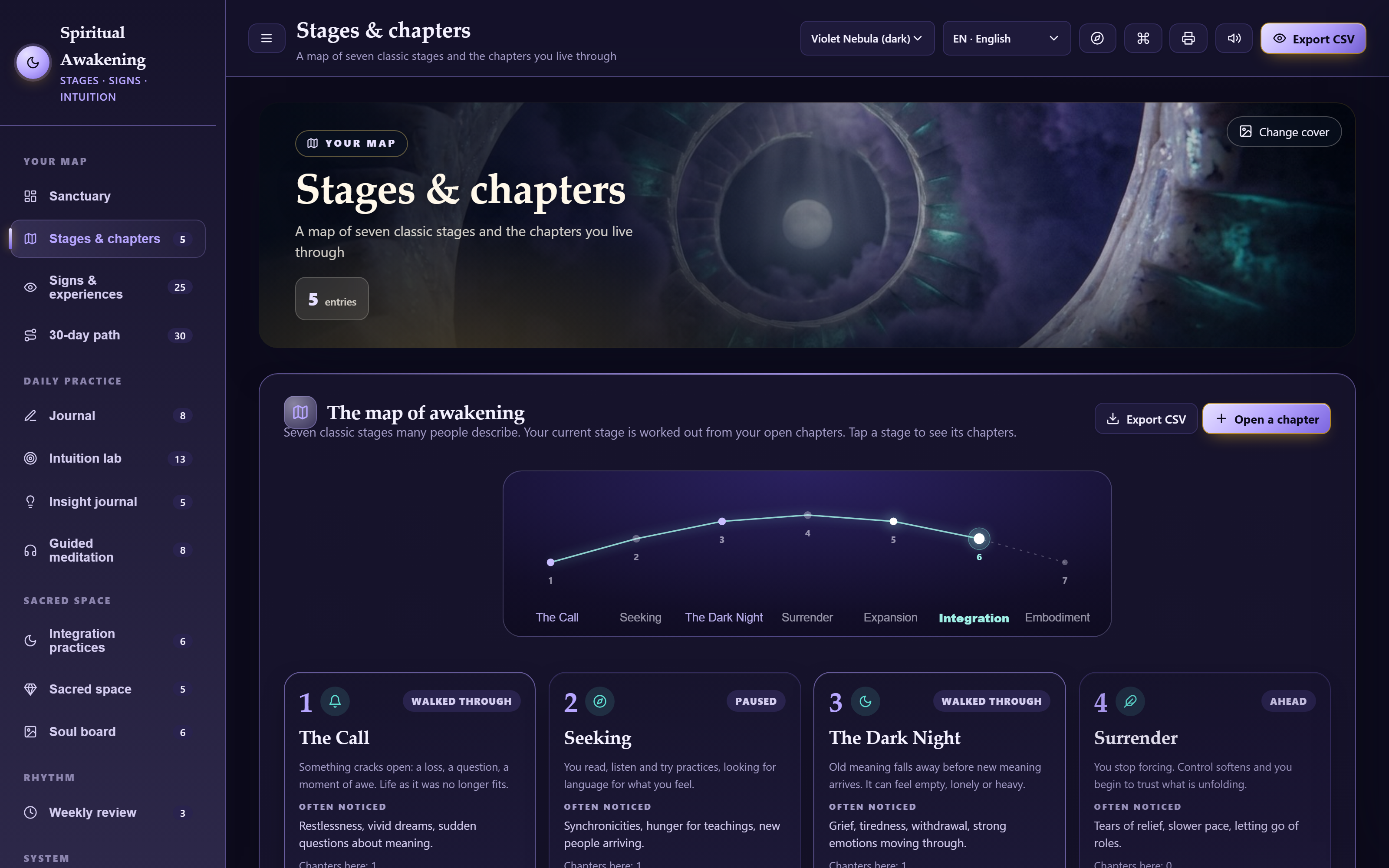
Most people recognise an awakening by its pattern over weeks, not by a single sign. A useful way to read the pattern is a map of seven classic stages that many teachers describe. The stages are not a ladder you climb once. People move back and forth, and two stages can overlap for months.
| Stage | What often happens | Often noticed |
|---|---|---|
| 1. The Call | Something cracks open: a loss, a question, a moment of awe | Restlessness, vivid dreams, questions about meaning |
| 2. Seeking | You read, listen and try practices | Synchronicities, hunger for teachings, new people |
| 3. The Dark Night | Old meaning falls away before new meaning arrives | Grief, tiredness, withdrawal |
| 4. Surrender | You stop forcing and begin to trust the process | Tears of relief, a slower pace |
| 5. Expansion | Openness and creativity return | Gratitude, a sense of connection |
| 6. Integration | Insights turn into habits and choices | Steadier days, clearer boundaries |
| 7. Embodiment | You live what you learned without needing to explain it | Quiet confidence, ordinary life feels meaningful |
Pick the stage that matches your last 14 days, not your best or worst day. If you sit between two stages, choose the earlier one. Being honest about stage 3 is especially useful, because it explains why an awakening can feel heavy rather than blissful. Our post on how to do shadow work to heal covers gentle tools for that part of the road.
The 30-Second Somatic Reset before you write
Self-check questions land better when your body is calm. Before you answer, take 30 seconds:
- Orient (10 seconds): feel your feet on the floor and name 3 places where your body is supported, for example feet, hips and back.
- Physiological sigh (15 seconds): take 2 short inhales through the nose, then 1 long, slow exhale through the mouth. Repeat twice.
- Look around (5 seconds): let your eyes rest on one calm object in the room, then pick up the pen.
In a 2023 Stanford study, people who practised cyclic sighing for 5 minutes a day for 1 month reported a larger improvement in mood than a mindfulness meditation group. Thirty seconds is a smaller dose, but it is enough to slow the pace of your answers.