Learning how to stop negative overthinking starts with interrupting repetitive threat loops before they spiral into all-night rumination. Combining a 30-second physiological sigh, a timed 5-minute brain dump, and a four-step evidence check shifts your nervous system from catastrophic guessing into one concrete, doable action today.
Interactive Practice Web App · Full Edition13 modules
Stop Overthinking Journal
Your mind feels quieter and you fall asleep more easily, and a daily check-in chart shows your thought loops getting softer over the weeks.
Web app for phone or laptop. Empty your mind in a timed brain dump, work through worries in four steps and play calm music. No birth date needed.
👥 38k+ students👥 38,000+ students · 2.4M+ community
$29.99$22.49$29.99₫659,000₫494,000₫659,000
Step 1 · Tap the struggle that stops you most:
How this app solves it for you
A timed brain dump of three to fifteen minutes empties your head onto the page, so you can finally put the day down and rest.
Included inside: A timed brain dump of 3, 5, 10 or 15 minutes counts your words and asks how heavy your mind felt before and after, so you can feel the relief.
Step 2 · Inspect real app screens inside
Noise-to-Fact Triage
13 modules · 2 live trial tabs
Structured dump separating confirmed facts from worst-case mental projections in under two minutes.
Pay once · Lifetime access · Instant email delivery
Yes. Stop Overthinking Journal — Brain Dump, Worry Journal, Clarity Techniques & Calm Music is built for this: Empty racing thoughts in a timed brain dump of 3 to 15 minutes and rate how heavy your mind felt before and after.
Enter your birthday to see your 2027 Personal Year and the angel number for each month, with space to write your intentions.
Learning how to stop negative overthinking starts with interrupting repetitive threat loops before they spiral into all-night rumination. Combining a 30-second physiological sigh, a timed 5-minute brain dump, and a four-step evidence check shifts your nervous system from catastrophic guessing into one concrete, doable action today.
When your mind replays awkward conversations or invents worst-case futures, arguing internally only feeds the loop with fresh emotional fuel. Before adopting the four-step protocol below, explore our how to stop overthinking at night real stories and journal guide to see how five everyday readers quieted 2 a.m. thought spirals using structured pages.
Reflection Disclaimer: Self-reflection exercises, cognitive thought logs, and breathing cues in this guide are personal mindfulness practices. They are not psychotherapy or medical care and do not diagnose, treat, or replace guidance from a licensed mental-health professional.
How to Stop Negative Overthinking in the Moment: 4-Step Interrupt
To break a negative overthinking loop in under 5 minutes, shift the thought out of silent rehearsal onto structured paper. Externalizing a single fear through four grounded questions lowers subjective mental noise by giving your brain an immediate endpoint rather than endless what-if loops.
Cognitive research on rumination in psychology shows that repetitive negative thinking feels productive because it mimics problem solving while actually keeping the stress response elevated. Studies on affect labeling demonstrate that putting exact words on an emotional state dampens amygdala reactivity within 30 to 90 seconds.
Follow this four-step interrupt sequence the moment you catch your thoughts spinning:
Step 1 — Name the Loop and Score Noise (30 Seconds): Rate how loud your mind feels right now on a 0-to-10 scale and assign the loop one category such as work, relationships, finances, or self. Naming the category signals metacognition—observing the thought instead of living inside it.
Step 2 — Run a Timed 3-to-5-Minute Brain Dump: Open a blank page, set a strict 3-minute or 5-minute countdown timer, and write every fragmented fear without editing punctuation or tone. Stopping on the bell prevents journaling from turning into a second round of rumination.
Step 3 — Separate Facts From Inventions: Circle one specific worry and write two columns beneath it: confirmed facts observable by a camera, and predictions your tired brain added afterward. Most catastrophic scenarios collapse once separated from observable evidence.
Step 4 — Pick One Controllable Step Under 10 Minutes: Sort the concern into three buckets—in your control, partly yours, or outside your control—then execute or schedule one concrete action so your nervous system sees closure.
If you prefer a structured workbook layout over blank pages, our comparison of worry journal and overthinking workbooks walks through thought diary templates and guided rumination sheets side by side.
Stopping Negative Overthinking at Night, in Relationships, and Anxiety
Negative overthinking intensifies in three high-friction settings: quiet midnight hours, unanswered relationship texts, and acute anxiety waves. Tailoring your reset to the exact trigger—sleep cues at night, evidence checks in relationships, and breath pacing during anxiety—prevents one-size-fits-all advice from failing under stress.
Understanding why each trigger behaves differently helps you deploy the right micro-tool in under 10 minutes instead of fighting willpower depletion:
At Night Before Sleep (10-Minute Offload): Fatigue weakens prefrontal filtering after 9 p.m., allowing unfinished daytime worries to sound urgent. Close screens 45 minutes before bed, complete a 5-minute timed brain dump, and pair your breathing with slow 432 Hz or 528 Hz ambient audio so your body feels the day is complete.
In Relationships (Mind-Reading Audit): Delayed replies or short text messages trigger cognitive distortions such as mind reading and fortune telling. Replace silent story-building with a three-line fact check: what was actually said, two benign reasons for the delay, and one calm question to ask tomorrow. For deeper post-conflict clarity, browse our relationship reflection journal prompts.
During Daytime Anxiety Spikes (Sensory Anchor First): High sympathetic arousal makes complex cognitive reframing almost impossible until pulse slows down. Drop into 30 seconds of physical breathing and orienting first, then return to writing once your jaw and shoulders loosen.
When deeper anger, self-doubt, or disproportionate sensitivity keeps pulling you into old emotional reactions, pairing gentle inquiry with the Shadow Work Journal & Sound Healing Guide lets you record each event in a 14-page Trigger Log with 0-to-10 intensity before and after reflection, map the unmet need underneath using a structured Shadow Map, write through twelve guiding questions, and unwind with two original instrumental soundscapes in 432 Hz and 528 Hz tunings with a fade-out timer.
Timed Brain Dump vs. 4-Step Worry Journal vs. Thought Trap Worksheet
Different negative overthinking patterns respond to distinct structured interventions rather than generic positive affirmations. Matching a racing flood to a 5-minute brain dump, a persistent fear to a 4-step worry check, or a harsh distortion to a cognitive trap question cuts mental fatigue across a 14-day practice cycle.
Use the decision matrix below to pick the exact practice matching how your mind is spinning right now:
Method
Recommended Time
Core Mechanism
Best Trigger Match
Measurable Shift
Timed Brain Dump
3, 5, 10, or 15 minutes
Uncensored writing until timer stops with before/after noise rating
Crowded mental tabs at bedtime or mid-afternoon overload
Immediate 2-to-4-point drop on a 0-to-10 mind-noise check-in
4-Step Worry Journal
6 to 8 minutes
Fear statement, evidence for/against, balanced view, one doable step + 3-day check
Recurring future scenarios ("what if this fails?")
Written track record showing most predicted fears never occurred
Relationship spirals, social replay, or perfectionist self-criticism
Lower belief percentage in harsh automatic assumptions
15-Minute Worry Window
Fixed 15 minutes daily
Deferring daytime worries to one scheduled afternoon container slot
All-day intrusive checking and constant mental reassurance seeking
Shorter daily duration of unscheduled daytime worry loops
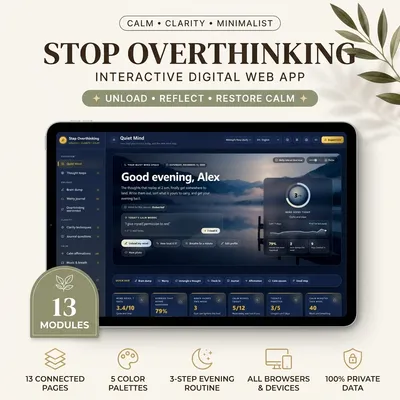
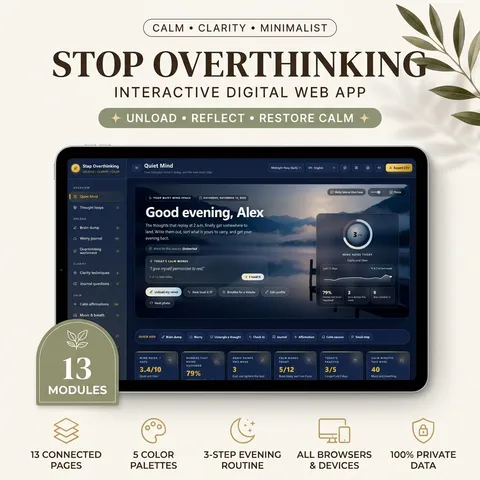
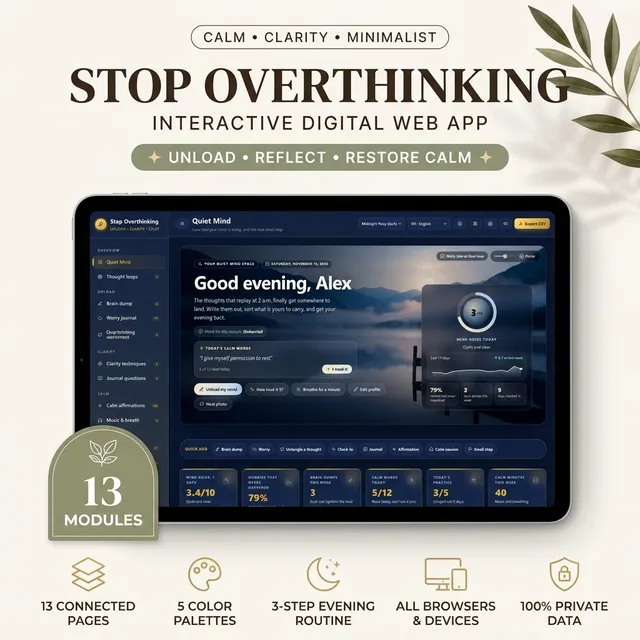
To hold all four methods together without scattered notes apps, the Stop Overthinking Journal connects 13 offline modules inside one private web app—including a Quiet Mind Dashboard with a mind-noise ring and 14-day sparkline trends, a Thought Loops Tracker across six life areas from looping to quiet and resolved, a Timed Brain Dump (3, 5, 10, or 15 minutes), a 4-Step Worry Journal, an Overthinking Worksheet covering eight cognitive thought traps, 8 Clarity Techniques, 60 guided prompts, 108 calm affirmations, and two original ambient pieces in 432 Hz and 528 Hz tunings.
If your negative loops frequently target your own worth after mistakes, check our self-reflection journal prompts guide for weekly honesty check-ins that replace self-punishment with balanced review.
30-Second Somatic Reset and 5-Minute Evening Worry Container Routine
Before attempting any cognitive worksheet, regulate your body for 30 seconds so breathing exits fight-or-flight urgency. Pairing that brief somatic pause with a consistent 5-minute evening worry container establishes a predictable daily boundary over 14 consecutive nights without requiring hours of meditation.
Thirty seconds of paced exhale breathing followed by a timed five-minute evening unload signals closure before sleep.
The 30-Second Somatic Reset Before Writing
A negative thought feels threatening partly because shallow chest breathing tells your brainstem danger is active right now. Run this 30-second physical reset before opening any notebook:
Physiological Sigh (15 Seconds): Take two quick consecutive inhales through your nose—one full breath followed immediately by a sharp top-off sip of air—then release a slow, unhurried six-second exhale through softly parted lips. Repeat twice to release ribcage tension.
Somatic Orienting (15 Seconds): Turn your head gently left and right to name three neutral objects in the room, then notice three solid contact points holding your weight: both heels on the floor, your back against the chair, and your forearms resting comfortably.
5-Minute Evening Worry Container Protocol
Once your body settles, follow this repeatable 300-second nightly close-down sequence at the same hour:
Minute 1 — Morning & Evening Mind Check-In: Tap a 0-to-10 score from calm water to a storm so weekly charts reveal real triggers across 30 days instead of guesswork.
Minutes 2–3 — Unload Remaining Loops: Transfer lingering tasks or social replays into your brain dump and tag any repeat pattern inside your thought loops tracker.
Minute 4 — Rewrite One Harsh Inner Critic Line: Cross out one absolute accusation ("I always ruin things") and write a fair, evidence-based statement next to it.
Minute 5 — Close With Music and Slow Breathing: Read one calm affirmation, set a 10-to-20-minute sleep timer on gentle 432 Hz music, and step away from phone feeds.
When negative overthinking stems from relentless self-criticism rather than external problems, pairing your evening routine with the Self-Love Journal & Confidence Affirmations gives you 16 private workspaces—including an Inner Critic Rewrite page where you physically cross out old harsh phrasing and track belief shifts over time, a timed 1-, 3-, or 5-minute Mirror Work Studio, 108 affirmations with a read-aloud breathing mode, and the 12-minute three-part voiced guided meditation "Coming Home to Yourself". For softer emotional safety when old memories fuel present worry, revisit our inner child meditation script before turning out the lights.
Apply it now
Put this article into practice
Over 8 years, members of a 2,400,000-strong community, including 38,000+ students, have reported real changes after keeping these practices up.
A private interactive web app to quiet a busy mind: untangle thought loops, four-step worry journal, timed brain dumps, 60 journal prompts, 108 affirmations and calming 432/528 Hz music.
Every hour Moon Keeper reads the sky, draws one tarot card and shares a calm 3-minute reflection. Drop by the altar, follow the hourly diary and leave a note in the guestbook.
One short email a day: a practice for today, a real reader story, and the newest guide on love, money and inner calm.
For more than 8 years, a community of over 2,400,000 followers and 38,000+ students has shared how these daily practices helped in love, money and inner calm.