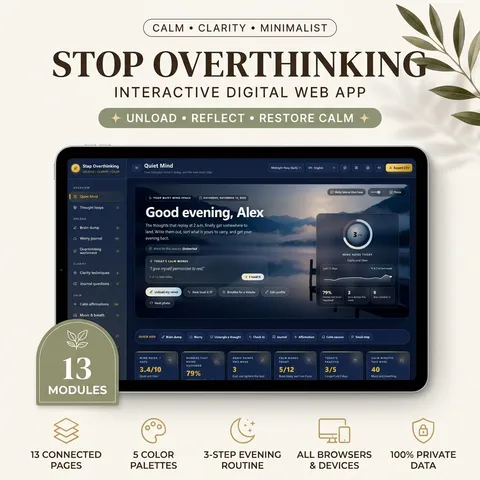
An effective overthinking workbook pairs a structured worry journal with timed thought-sorting rules so repetitive mental loops move onto paper, separate controllable decisions from noise, and close with a single concrete next action rather than passive venting.
Interactive Practice Web App · Full Edition13 modules
Stop Overthinking Journal
Your mind feels quieter and you fall asleep more easily, and a daily check-in chart shows your thought loops getting softer over the weeks.
Web app for phone or laptop. Empty your mind in a timed brain dump, work through worries in four steps and play calm music. No birth date needed.
★★★★★ 4.9 · 38k+ students★★★★★ 4.9/5 · 38,000+ Students · 2.4M+ Community
$29.99$22.49$29.99₫659,000₫494,000₫659,000
Step 1 · Tap the struggle that stops you most:
How this app solves it for you
A timed brain dump of three to fifteen minutes empties your head onto the page, so you can finally put the day down and rest.
Included inside: A timed brain dump of 3, 5, 10 or 15 minutes counts your words and asks how heavy your mind felt before and after, so you can feel the relief.
Step 2 · Inspect real app screens inside
Noise-to-Fact Triage
13 modules · 2 live trial tabs
Structured dump separating confirmed facts from worst-case mental projections in under two minutes.
Pay once · Lifetime access · Instant email delivery
Yes. Stop Overthinking Journal — Brain Dump, Worry Journal, Clarity Techniques & Calm Music is built for this: Empty racing thoughts in a timed brain dump of 3 to 15 minutes and rate how heavy your mind felt before and after.
Enter your birthday to see your 2027 Personal Year and the angel number for each month, with space to write your intentions.
An effective overthinking workbook combines guided cognitive sorting with a dedicated worry journal so looping "what if" thoughts leave your working memory in under ten minutes. Instead of endlessly rehearsing worst-case scenarios, structured prompts separate verifiable facts from mental noise and assign one realistic next action before you close the page.
Most people abandon generic blank notebooks within five days because writing unfocused frustration reinforces the exact loop they hoped to escape. Pairing present-moment grounding from our Power of Now mental-noise release guide with clear external containers keeps reflection concise, honest, and actionable.
Educational & Reflective Disclaimer: This guide covers reflective writing habits and decision-hygiene frameworks for everyday mental clutter. It is educational only and never substitutes for licensed medical, psychological, or psychiatric advice or care.
Overthinking Workbook Design: Breaking Repetitive Thought Loops
When a thought spins silently in working memory, your nervous system treats an unresolved ambiguity like an active threat requiring constant background monitoring. An organized overthinking workbook interrupts that circular rehearsal by forcing every vague fear through three rapid filters: factual trigger, sphere of control, and smallest concrete step.
Research on expressive writing and cognitive offloading notes that unlabeled rumination activates endless rehearsal, whereas labeling emotions on paper and moving directly into structured evaluation lowers mental strain. Good workbooks do not ask you to write three poetic pages at midnight; they guide your attention along an exact guardrail so your brain gets permission to set the problem down.
Trigger Separation: Distinguishes what actually happened today (a terse message, a delayed invoice, an unclear deadline) from the narrative your mind attached afterward.
Timed Offloading Containers: Caps active writing at five to ten minutes so the worry journal serves as a release valve rather than a secondary rehearsal stage.
Decision-to-Noise Sorting: Splits concerns into two buckets—items needing one 10-minute action tomorrow versus unactionable unknowns that belong in a scheduled holding list.
Sensory Closure Signal: Pairs your written summary with a physical reset so your body notices the transition back into focus or rest.
How to Use an Overthinking Workbook and Worry Journal Step by Step
Knowing how to organize a worry journal matters just as much as the prompts inside it. Follow this four-step routine whenever mental static threatens to hijack your afternoon or delay your sleep.
Step 1 — Run a 4-Minute Unfiltered Dump: Set a short countdown timer and list every nagging thought in plain bullet phrases without editing grammar or judging whether it sounds dramatic. Getting fragments out of short-term memory reduces immediate cognitive load.
Step 2 — Run the Four-Step Worry Audit: Pick only the loudest line item from your list and answer four focused questions: What exact outcome am I bracing for? What observable evidence supports or contradicts it? What would I tell a close colleague facing this exact constraint? What is one tiny step within my control over the next 24 hours?
Step 3 — Park Uncontrollable Variables in a "Worry Window": Many behavioral frameworks highlighted by the American Psychological Association reference stimulus-control strategies for scheduled worry time. Move items you cannot resolve tonight into a designated 15-minute review slot at 4:30 PM tomorrow, freeing tonight for sleep.
Step 4 — Anchor One Micro-Commitment: Write one single verb-led action on your calendar (for example, "Send clarification email at 9:15 AM") and close the session. Actionable closure tells your brain the open loop is safely captured.
The 30-Second Somatic Reset Before Opening Your Workbook
Starting a written clarity exercise while shoulders are tight and breathing stays shallow often pours urgency directly onto the page. Before typing or picking up your pen, take thirty seconds to complete two quick consecutive inhales through your nose, followed by one slow six-second exhale through your mouth. Notice three physical points of support—both feet flat on the floor, your lower back against the chair, and your forearms resting comfortably on the desk—so your analytical thinking comes back online cleanly.
Interactive Worry Journals vs Static Overthinking Workbooks
Readers shopping for a workbook quickly discover three distinct formats: printable PDF worksheets, bound paper journals, and private interactive web-app journals. Choosing the right container depends on whether you lose momentum organizing loose pages or struggle to switch off distracting notifications while writing.
Workbook Criterion
Blank Paper / Loose PDF Worksheets
Interactive Web-App Worry Journal
Habit Note Apps (Notion / Docs)
Loop-Breaking Speed
Slow if you have to build prompts manually each day
Immediate 4-step clarity flow and built-in session timer
Moderate; easy to get distracted formatting tables
Pattern Recognition
Difficult to search back across previous weeks
Keeps prompts, worry audits, and logs in one private place
Searchable, though lacks guided nervous-system pacing
Distraction Resistance
Zero digital notifications
Offline browser ready in a distraction-free workspace
High notification spillover inside shared work tabs
Best Fit For
Tactile weekend reflections at a clean desk
Fast daytime resets, clarity loops, and quiet evening routines
Long-term project documentation and archival wikis
For readers comparing lightweight offline tools against bloated subscription apps, our roundup of the best cross-platform journal apps breaks down privacy, pricing models, and offline portability across devices.
Adapting Worry Journal Prompts for Nighttime Loops and Daytime Decisions
An overthinking habit rarely shows up the same way at 2:00 PM during work hours as it does at 11:30 PM when lights go out. Tailoring your workbook prompts to the exact context keeps the habit effortless rather than feeling like extra homework.
Daytime Decision Gridlock & Perfectionism Loops
Afternoon overthinking usually hides behind "more research" before sending a proposal, setting boundaries, or shipping creative work. Keep your mid-day workbook prompt strictly two lines long: "What irreversible downside actually exists if this choice is 80% optimal?" and "What 15-minute reversible test gives me real data today?" Ninety percent of daytime hesitation collapses once you recognize a reversible step instead of treating every email like a lifetime contract.
Never start deep analytical problem-solving in bed. Keep a short bedside capture rule: jot down the topic in under six words, write tomorrow's 4:30 PM review time beside it, and end the note immediately. Deferring analysis until daylight teaches your nervous system that bed belongs exclusively to rest rather than midnight rehearsal.
Concrete Example: Sorting a Real Workplace Concern in Three Minutes
Consider a common Sunday evening loop: worrying that a manager's brief message Friday afternoon means dissatisfaction with your proposal. Inside an unguided notebook, that vague fear can sprawl into two hours of career catastrophizing. Inside an overthinking workbook, the prompt constrains you to observable reality: the literal message was only four words before the weekend rush, your prior three deliverables passed without revision, and Tuesday's review meeting sits outside tomorrow's schedule. That quick audit turns a paralyzing assumption into one simple Monday 9:00 AM checklist line—confirm agenda points calmly—freeing the rest of your weekend.
A Guided Interactive Option When You Want Everything Built In
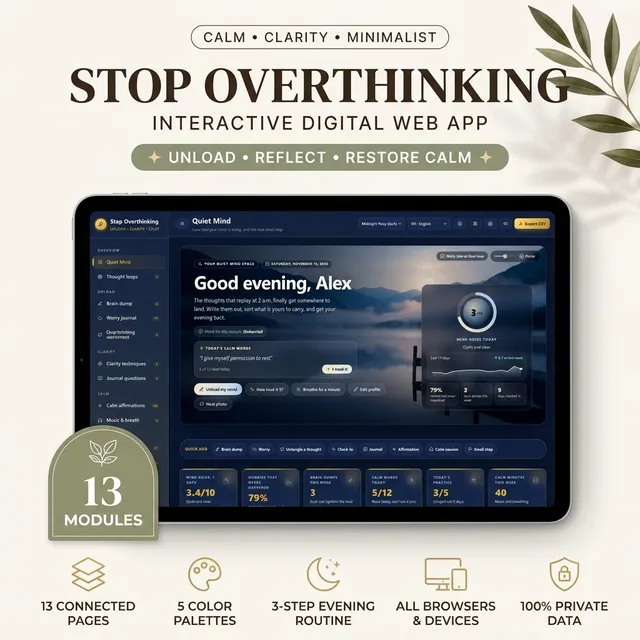
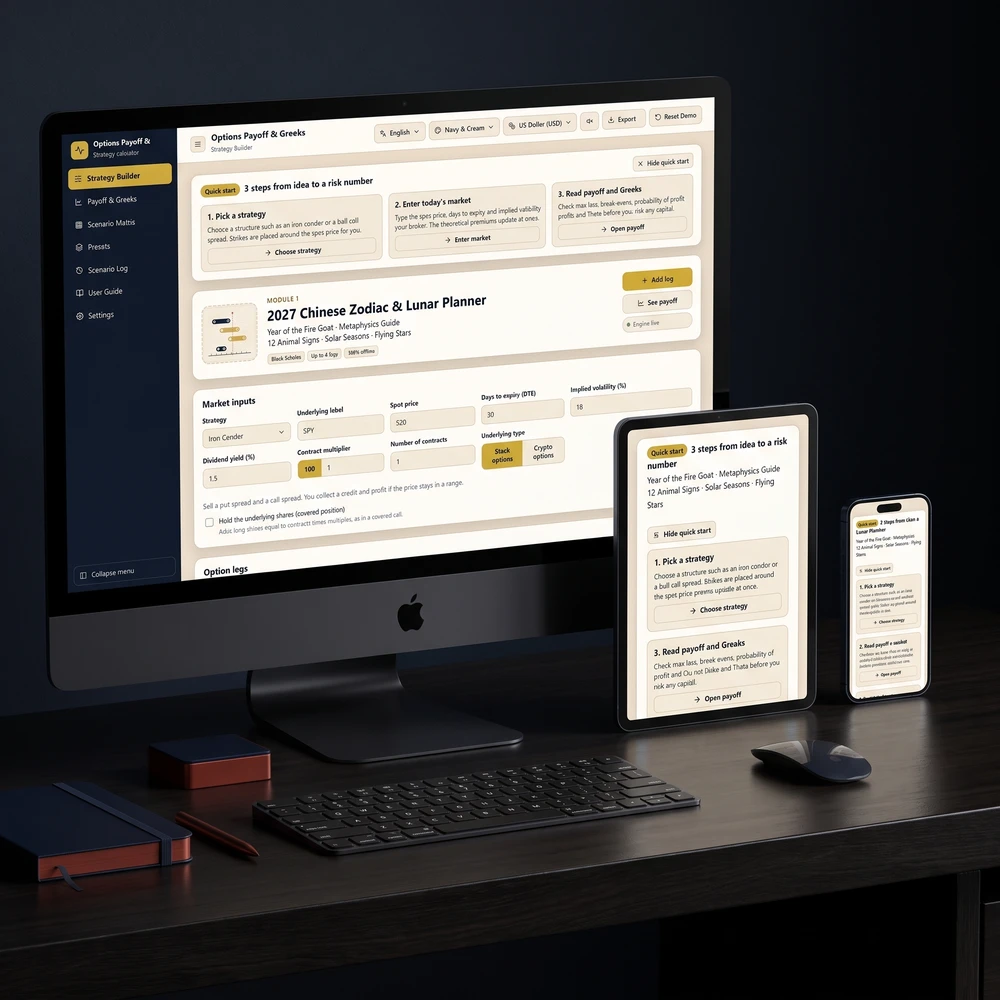
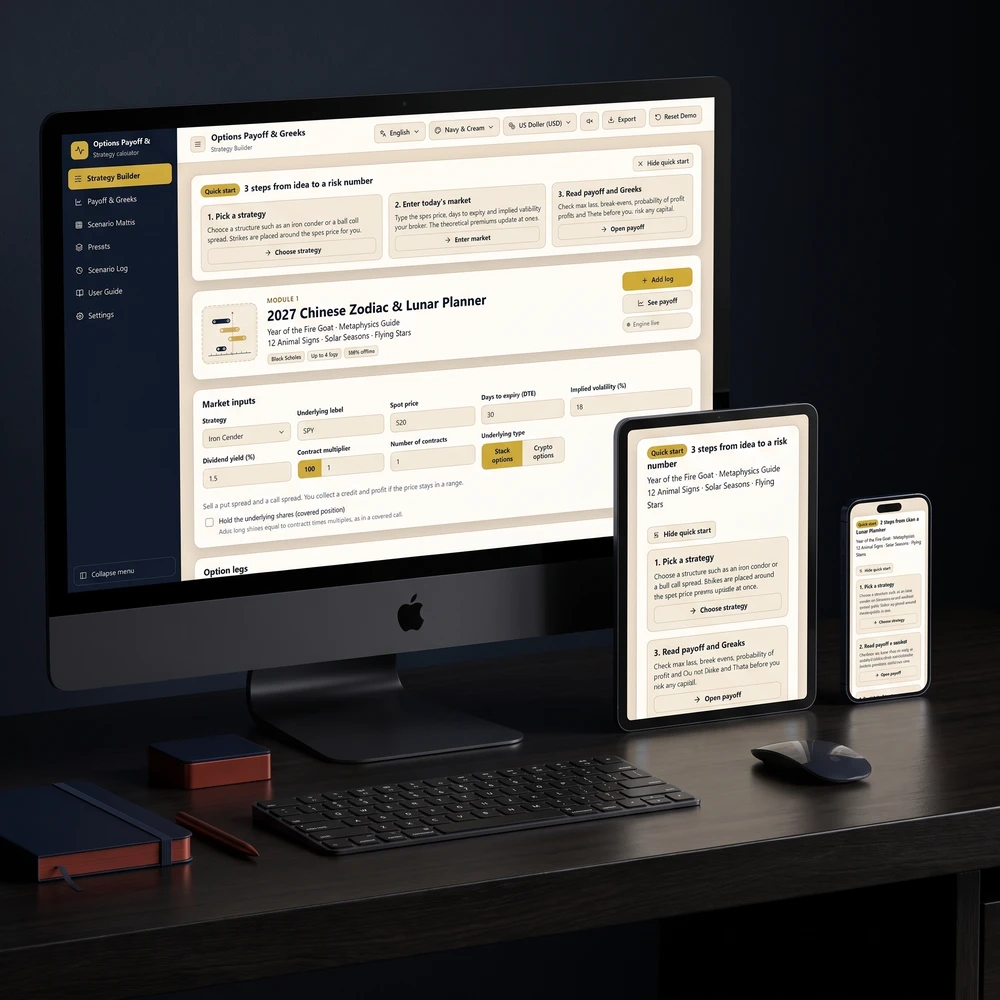
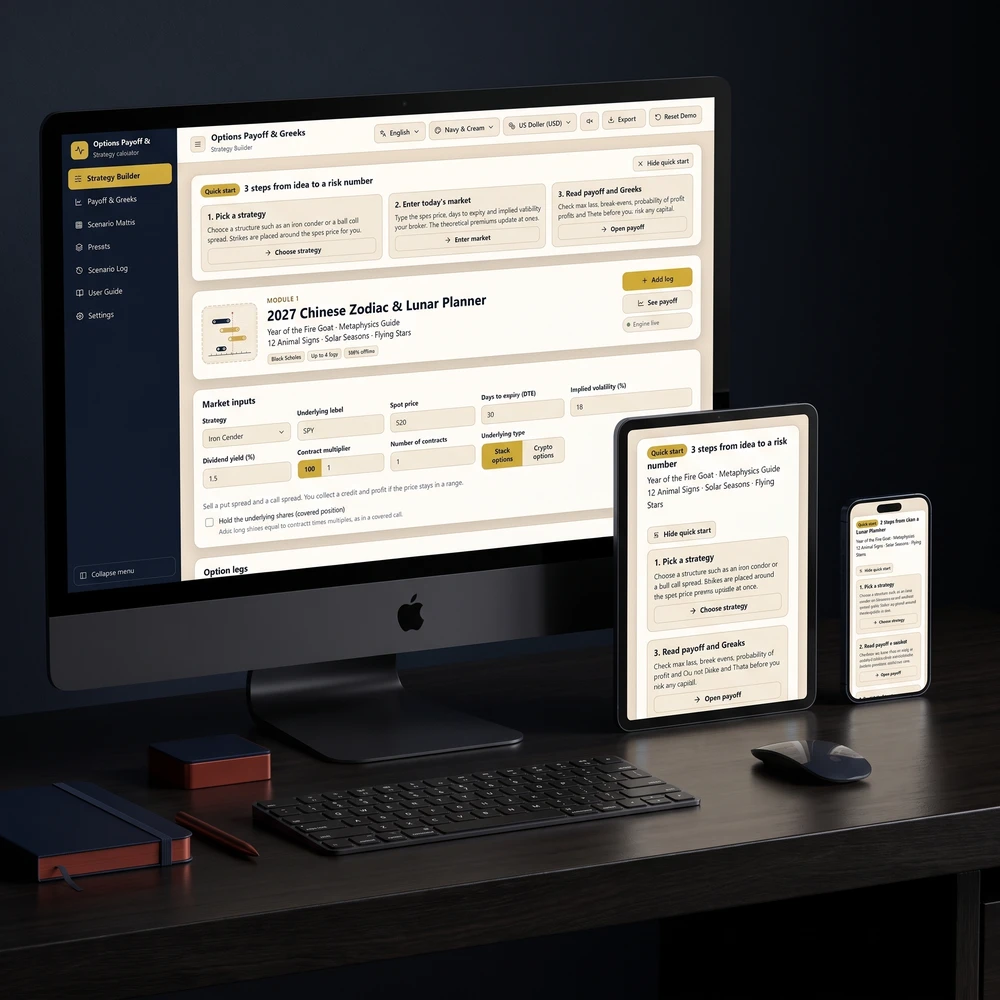
If you want a ready-made quiet environment instead of rebuilding PDF checklists every week, the Stop Overthinking Journal brings a four-step worry journal, timed offloading space, clarity techniques, 60 journal prompts, 108 affirmations, and calm 432/528 Hz soundscapes into a private web app with zero monthly subscription. You can also explore deeper pattern work inside the Shadow Work Journal & Sound Healing Guide when repetitive emotional triggers keep resurfacing around specific relationships.
Start tonight with one ten-minute experiment: sort a single recurring worry onto paper, assign one 24-hour action, park the rest until tomorrow afternoon, and notice how much quieter your evening becomes.
Apply it now
Put this article into practice
Over 8 years, members of a 2,400,000-strong community, including 38,000+ students, have reported real changes after keeping these practices up.
Understand your reactions and gently heal old patterns. Name the themes you keep circling, map each shadow part, log what sets you off and discover what truly helps you calm down.
For more than 8 years, a community of over 2,400,000 followers and 38,000+ students has shared how these daily practices helped in love, money and inner calm.
A private interactive web app to quiet a busy mind: untangle thought loops, four-step worry journal, timed brain dumps, 60 journal prompts, 108 affirmations and calming 432/528 Hz music.
Every hour Moon Keeper reads the sky, draws one tarot card and shares a calm 3-minute reflection. Drop by the altar, follow the hourly diary and leave a note in the guestbook.
One short email a day: a practice for today, a real reader story, and the newest guide on love, money and inner calm.
For more than 8 years, a community of over 2,400,000 followers and 38,000+ students has shared how these daily practices helped in love, money and inner calm.