



Skip to content

Instant access after payment

Yin YangMasters
ShopCart

End of Year Journal Prompts: 30 Questions for Late December

Jennie Uyen Chu
Jennie Uyen Chu
Consciousness & Energy Expert
End of Year Journal Prompts: 30 Questions for Late December

Direct Answer

End of year journal prompts are a structured set of 30 reflection questions designed to close the past twelve months in 7 days using 15-minute daily sessions. Grounded in the Peak–End Rule and expressive writing research, this protocol pairs your year in review template with real calendar records so you finish December with clear priorities for 2027.

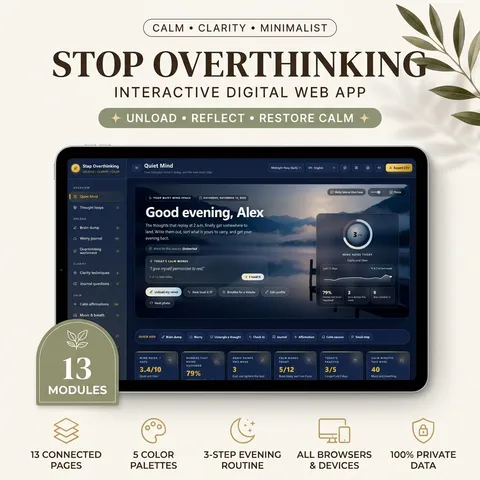
Interactive Practice Web App · Full Edition13 modules

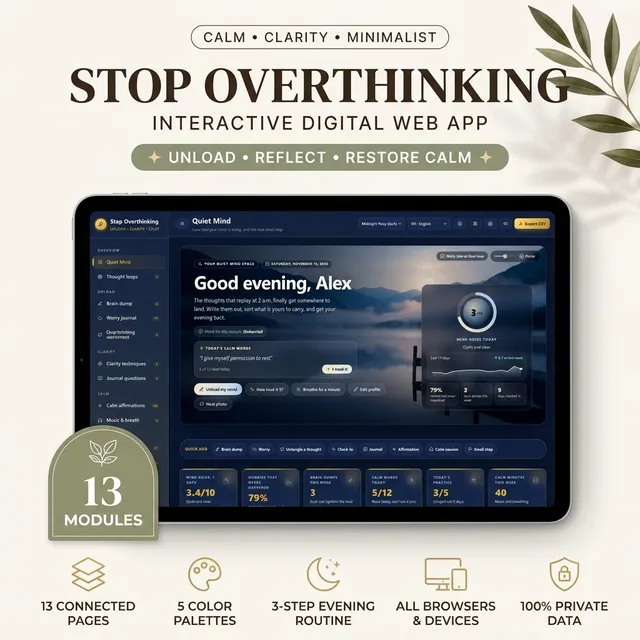
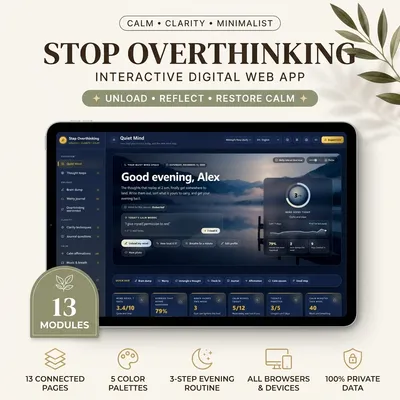
Stop Overthinking Journal

Your mind feels quieter and you fall asleep more easily, and a daily check-in chart shows your thought loops getting softer over the weeks.

Web app for phone or laptop. Empty your mind in a timed brain dump, work through worries in four steps and play calm music. No birth date needed.

👥 38k+ students
$29.99$22.49$29.99₫659,000₫494,000₫659,000

Pay once · Lifetime access · Instant email delivery

Quick answers

Yes. Stop Overthinking Journal — Brain Dump, Worry Journal, Clarity Techniques & Calm Music is built for this: Empty racing thoughts in a timed brain dump of 3 to 15 minutes and rate how heavy your mind felt before and after.

Stop Overthinking Journal — Brain Dump, Worry Journal, Clarity Techniques & Calm MusicStop Overthinking Journal — Brain Dump, Worry Journal, Clarity Techniques & Calm MusicExplore Interactive Workbook →

Your free 2027 Angel Number Year Map

Enter your birthday to see your 2027 Personal Year and the angel number for each month, with space to write your intentions.

No spam, unsubscribe anytime.

End of year journal prompts are a structured set of 30 reflection questions designed to close the past twelve months in 7 days using 15-minute daily sessions. Grounded in the Peak–End Rule and expressive writing research, this protocol pairs your year in review template with real calendar records so you finish December with clear priorities for 2027.

Most people skip year-end reflection because a blank page feels too large. When you rely on memory alone, the Peak–End Rule causes your brain to judge the entire year by its most intense moment and its final week. Pairing focused prompts with your calendar, photos, and notes turns vague feelings into concrete lessons you can actually use.

30 End of Year Journal Prompts for the Final Week of December

Set a 15-minute timer for each group of six questions below, writing two to three honest sentences per prompt instead of long essays. Research on expressive writing shows that brief, structured sessions of 15 to 20 minutes lower cognitive clutter without triggering emotional overwhelm.

Group 1: Moments & Facts (What Actually Happened)

  1. What were the three biggest turning points of my year, based on my calendar rather than memory?
  2. Which project or commitment did I finish that I am genuinely proud of?
  3. What did I start with enthusiasm and leave unfinished, and at which month did it stall?
  4. Where did most of my discretionary time go across Q1, Q2, Q3, and Q4?
  5. Who were the five people I spent the most hours with, and how did those hours feel?
  6. What was my single best ordinary day this year, and what made it work?

Group 2: Energy & Boundaries (What Drained or Restored Me)

  1. When did I feel most like myself without forcing anything?
  2. Which recurring obligation or habit drained my energy week after week?
  3. Which daily or weekly habit supported my focus the most when life got busy?
  4. What boundary did I set—or fail to set—that changed the tone of my autumn?
  5. What did I avoid confronting for more than three months, and what did delaying it cost me?
  6. If this year were a chapter title in a book, what three words would name it?

Group 3: Honest Lessons (What the Data Reveals)

  1. What is one belief I held last January that real experience disproved by December?
  2. Which decision would I make again without hesitation, even knowing the effort it took?
  3. Which decision would I handle differently, and what early signal did I overlook?
  4. What pattern repeats across my answers in Groups 1 and 2?
  5. Which two commitments or distractions must I stop carrying into January?
  6. What skill or habit compounded faster than I expected once I practiced it consistently?

Group 4: Relationships & Gratitude (Who Mattered Most)

  1. Who showed up for me during my hardest week, and have I thanked them directly?
  2. Which relationship grew stronger through small, consistent check-ins?
  3. What unexpected gift, opportunity, or quiet win am I grateful for that was not on my January list?
  4. Where did I over-explain or over-give out of habit rather than genuine care?
  5. What conversation do I want to have before the year closes so nothing lingers?
  6. How did I treat myself on the days when my plans fell apart?

Group 5: 2027 Direction (Turning Reflection Into Action)

  1. What are the three to five measurable goals that matter most for my next twelve months?
  2. Which single daily or weekly habit would move my most important 2027 goal forward?
  3. What will I say no to in Q1 so those three to five goals have breathing room?
  4. What is my one-word anchor or practical theme for 2027?
  5. What obstacle is most likely to derail me in February, and what is my pre-planned response?
  6. On which exact day and time each week will I review my progress?

7-Day December Reflection Schedule and Printable Journal Setup

Spreading 30 prompts across seven 15-minute sessions between December 26 and January 1 prevents decision fatigue and keeps your entries grounded in real records. Before you write a single line on any day, take 30 seconds for a physiological sigh—two quick inhales through the nose followed by one slow exhale through the mouth—to shift your nervous system out of end-of-year rush.

Use the 15-Minute Container Protocol: when the timer ends, close your notebook and return to your day rather than ruminating over unresolved answers. If you want a deeper weekly cadence after December, pair this table with our self-reflection journal prompts or run a full life audit workbook reset.

Day Prompt Group Time Box Record to Open Concrete Output
Dec 26 Gather & Scan 15 min Calendar & photo roll 12 one-line month summaries
Dec 27 Group 1: Moments & Facts 15 min Month summaries 6 factual answers (prompts 1–6)
Dec 28 Group 2: Energy & Boundaries 15 min Work & health notes Top 3 energy drains named
Dec 29 Group 3: Honest Lessons 15 min Bank & project logs 2 habits to stop in January
Dec 30 Group 4: Relationships & Gratitude 15 min Messages & contacts 2 thank-you notes sent
Dec 31 Group 5: 2027 Direction 15 min Answers from Days 1–5 3–5 goals + 1 keystone habit
Jan 1 Lock Weekly Check-In 10 min 2027 calendar Recurring Sunday 10-min review

To set up a printable or clean digital page, create one two-column sheet per group: prompts on the left, three-line answer boxes on the right, and a single summary line at the bottom. Keeping each day to one page ensures you finish all seven days without needing a weekend retreat. If you prefer writing by hand, print all seven sheets on Sunday evening and clip them into a single folder beside a pen so there is zero friction when you sit down at night. Once January arrives, keep those seven completed sheets at the front of your notebook and review the one-line summaries at the end of Q1 to verify whether your daily schedule actually matches the priorities you chose in December.

Calm hands resting beside a handmade paper journal, a lit beeswax taper candle, and blank cream index cards on a wooden desk at dusk
Fifteen quiet minutes with your calendar and a clean page is enough to close December with clarity.

How to Adapt Year-End Prompts for Students, Faith, and Daily Habits

One core framework adapts cleanly to students, faith-based reflection, and daily habit builders when you swap the lens on Groups 1, 4, and 5. Research on implementation intentions shows that linking a specific cue ("every Sunday at 5 PM") to a concrete action doubles follow-through compared to vague resolutions.

  • For students closing a semester: Replace work project questions in Group 1 with courses, study blocks, and exam prep habits. Ask which study environment produced your highest focus and which late-night routine hurt your retention.
  • For Christian or faith-centered reflection: Frame Group 4 around stewardship, answered prayers, and quiet moments of grace. Ask where you sensed peace during uncertainty and how you want to serve your community in 2027.
  • For daily habit builders: Turn Prompt 26 into a 30-day starter experiment rather than a 365-day vow. Pair your chosen habit with weekly Sunday reset planning templates and a 90-day quarterly goal-setting system for 2027 so your December insights stay visible.

If you want your year-end answers to connect directly to next year's daily execution, the 2027 Digital Planner & Goal Tracker links your 2027 goals to a twelve-month milestone strip and a weekly habit grid. Its Weekly Review calculates your habit streaks and milestone pace automatically, so next December you can review real numbers instead of guessing.

Apply it now

Put this article into practice

Over 8 years, members of a 2,400,000-strong community, including 38,000+ students, have reported real changes after keeping these practices up.

2027 Digital Planner — Goal Planner, Monthly Calendar & Zodiac Year Forecast
In our shop

2027 Planner (Goals, Habits & Moon Calendar)

Make 2027 the year your goals actually happen. Every daily habit is tied to a real goal, a pace line shows whether you are on track, and your weekly review fills itself in.

Sources & Verified References

Reviewed for practical mindfulness & personal development alignment. Editorial Policy

Year in Review Template: 24 Questions to Close Your Year and Plan the Next

Pillar Topic

Year in Review Template: 24 Questions to Close Your Year and Plan the Next

Read Guide →
Real stories

How readers changed with these practices

Over 8 years, members of a 2,400,000-strong community, including 38,000+ students, have reported real changes after keeping these practices up.

See all stories →
Stop Overthinking Journal — Brain Dump, Worry Journal, Clarity Techniques & Calm Music
🔥 Start Day 1 Tonight · Buy Once, Use Forever

Stop Overthinking Journal — Brain Dump, Worry Journal, Clarity Techniques & Calm Music

A private interactive web app to quiet a busy mind: untangle thought loops, four-step worry journal, timed brain dumps, 60 journal prompts, 108 affirmations and calming 432/528 Hz music.

FREE INTERACTIVE GUIDE

Get Your Free 2027 Angel Number Year Map

Enter your birthday to reveal your 2027 Personal Year, the angel number guiding each month, and a private workspace to set your intentions.

100% privacy protected. No spam, unsubscribe anytime.

Ask Yinyang Masters inside your AI assistant

Get the same calculations and guidance right in your chat: add the free Yinyang Masters app, then ask in plain English. No account needed.

Try asking: “Find a Yinyang Masters guide about starting a daily spiritual practice.”

Moon Keeper, a white fox in a dark robe, meditating by candlelight
Live now

Meet Moon Keeper, our live altar host

Every hour Moon Keeper reads the sky, draws one tarot card and shares a calm 3-minute reflection. Drop by the altar, follow the hourly diary and leave a note in the guestbook.

FREE DAILY NEWSLETTER

Get the Yin Yang Masters Letter Every Day

One short email a day: a practice for today, a real reader story, and the newest guide on love, money and inner calm.

For more than 8 years, a community of over 2,400,000 followers and 38,000+ students has shared how these daily practices helped in love, money and inner calm.

100% privacy protected. No spam, unsubscribe anytime.