Ho'oponopono for sleep is a 10-minute bedtime routine that repeats four phrases (I love you, I'm sorry, please forgive me, thank you) for 12 slow rounds of about 20 seconds each, so the last thing your mind rehearses is release instead of replay. It is a calming ritual, not a sleep treatment.
Interactive Practice Web App · Full Edition14 modules
Shadow Work Journal & Sound Healing Guide
You learn what really triggers you and which tools calm you down fastest, laid out on a simple weekly chart.
Web app for phone or laptop. Log triggers, answer shadow work prompts and play the listening deck. No birth date needed.
👥 38k+ students👥 38,000+ students · 2.4M+ community
$27.99$20.99$27.99₫609,000₫456,000₫609,000
Step 1 · Tap the struggle that stops you most:
How this app solves it for you
A trigger log captures what set you off and what eased it, so the pattern finally loosens its grip.
Included inside: Themes gather every entry about the reactions and fears you keep returning to, so you finally see the pattern instead of isolated bad days.
Step 2 · Inspect real app screens inside
Healing Overview
14 modules · 2 live trial tabs
Organized command view tracking active shadow themes, emotional patterns, and ready-to-open guided tabs.
Pay once · Lifetime access · Instant email delivery
Yes. 30-Day Shadow Work Starter Journal — Trigger Log, Shadow Map & Writing Prompts is built for this: Log what sets you off with its strength from 0 to 10 before and after, and see which tool eases things for you most.
Enter your birthday to see your 2027 Personal Year and the angel number for each month, with space to write your intentions.
Ho'oponopono for sleep is a 10-minute bedtime routine that repeats four short phrases (I love you, I'm sorry, please forgive me, thank you) for 12 slow rounds, so the last thing your mind rehearses is release instead of replay. It pairs a Hawaiian reconciliation practice with a 4-minute pace and a 30-second breathing reset. It is a calming ritual, not a sleep treatment. For the full background, read the Ho'oponopono cleansing and forgiveness guide.
Most people reach for Ho'oponopono at night because the mind gets loudest in bed: an awkward conversation, an unpaid bill, a message left on read. The four phrases give that loop a script with an ending. Below you get the exact routine, a pacing table, a 7-night log you can copy into any notebook, and the limits of what a bedtime practice can do.
Ho'oponopono for Sleep: The 4-Phrase Bedtime Routine
The routine takes 10 minutes from lights-dim to lights-out. Twelve rounds of the four phrases at a slow pace last about 4 minutes; the rest of the time goes to setup and a quiet close. Keep the sequence identical every night, because a repeated cue is what turns a practice into a bedtime signal.
Minutes 0 to 2, set the room. Dim the lights, put your phone out of arm's reach, and sit or lie down in your usual sleep position.
Minute 2, name one thing. Pick the single memory, person, or worry that is loudest right now. Name it in one short sentence, such as "the argument at lunch." Only one item per night.
Minutes 2 to 6, say the four phrases. Say each phrase silently on a slow exhale: "I love you. I'm sorry. Please forgive me. Thank you." That is one round. Complete 12 rounds, about 20 seconds each.
Minutes 6 to 8, stay with the sensation. Stop the words. Notice where the memory sits in your body, whether chest, jaw, or stomach, and let your attention rest there without trying to change it.
Minutes 8 to 10, close the container. Say "that is enough for tonight," turn over, and let the practice end. You do not need to feel different for it to count.
The phrases are aimed at your own replay loops, not at the other person. In this practice you are not confessing to something you did not do; you are acknowledging the memory that keeps playing and offering it a way to wind down.
Ho'oponopono Prayer for Sleep: Pacing, Breath, and a 7-Night Log
Fast repetition keeps the mind busy, and a busy mind is the opposite of what you want at 11 p.m. Pace the words to your exhale, and use a short breathing reset first if your body feels wired.
The 30-Second Somatic Reset (do this before round one)
Take two quick sips of air through the nose, then one long, slow exhale through the mouth. Repeat for 30 seconds, then let your eyes rest on three fixed points in the room, such as the door frame, the lamp, and the window edge. A randomized controlled study in Cell Reports Medicine found that 5 minutes a day of exhale-focused "cyclic sighing" for one month improved mood and lowered breathing rate more than the same time spent in mindfulness meditation. The study measured mood and arousal, not sleep, so treat the reset as a way to lower the volume before the words begin.
Pacing table
Moment
Pace
What you are doing
Rounds 1 to 4
About 6 seconds per phrase
Matching each phrase to one full exhale
Rounds 5 to 8
About 5 seconds per phrase
Letting the rhythm settle without speeding up
Rounds 9 to 12
About 4 seconds per phrase
Dropping the effort; words get quieter
After round 12
No words
Resting attention on the body sensation
The 7-night bedtime log
One line per night is enough. Rate how busy your mind feels on a 1 to 5 scale before and after, where 5 is "racing." After 7 nights you have a personal baseline instead of a guess.
Night
Item you named
Rounds done
Mind-busy before (1-5)
Mind-busy after (1-5)
Note
1
12
2
12
3
12
4
12
5
12
6
12
7
12
If your "after" score does not drop by at least 1 point on 4 of the 7 nights, change one variable only: shorten to 6 rounds, move the practice 30 minutes earlier, or swap the spoken words for a silent count. Changing one thing at a time tells you which adjustment worked.
Action, then release
If the item you named needs a real step, such as an email or a payment, write that one step on paper before the rounds, then put the paper face down. The practice is for the replay, the paper is for the task. Closing the loop on paper keeps you from checking the result in bed.
What Ho'oponopono Meditation Is (and Where the Four Phrases Come From)
Ho'oponopono is a Hawaiian practice whose name translates to "to make right." In its traditional form it was a family gathering where relatives talked through a broken relationship until it was repaired, sometimes daily or weekly. As described on the Ho'oponopono entry, a healing practitioner named Morrnah Simeona adapted it in 1976 into a private, self-directed method, and the four-phrase version became widely known through psychologist Ihaleakala Hew Len and the 2007 book Zero Limits.
That history matters for one practical reason: the phrase order is not fixed. Some teachers begin with "I love you," others with "I'm sorry." Pick one order and keep it for all 7 nights, because consistency matters more than the particular sequence.
Treat the practice as a reflective ritual. The claim that it changes outside events is a belief, not a measured result, and this routine does not depend on it. What the routine does offer is a repeatable 10-minute structure for ending the day with forgiveness language instead of rumination.
Ho'oponopono for Insomnia and Deep Sleep: What to Expect and When to Get Help
A bedtime ritual can make winding down easier, and it can sit alongside ordinary sleep hygiene: a regular bedtime, a dim room, and no screens in the last 30 minutes. It is not a treatment for insomnia. Chronic insomnia is generally defined as trouble sleeping at least 3 nights a week for at least 3 months, and that pattern deserves a conversation with a doctor or sleep specialist, not another ritual.
What you notice
Reasonable response
Mind slows within 10 to 20 minutes
Keep the routine as written
Phrases feel forced or irritating
Drop to 6 rounds or use silent breathing only
Strong emotion rises (tears, tight chest)
Stop the words, breathe, and write one line in your log
Poor sleep 3 nights a week for 3 months
Book an appointment with a clinician
If a particular memory is heavy enough that it returns every night, such as grief or a painful relationship, a licensed counselor is a better partner for it than a bedtime phrase. The routine is a gentle support, and it works best on ordinary daily friction.
Ho'oponopono Music and Sleep Talk-Downs: Audio Without the Overstimulation
Many people ask about playing Ho'oponopono music or a guided talk-down. Audio can help you keep a steady pace, with two limits. Choose tracks with no sudden volume changes, and set a sleep timer for 20 to 30 minutes so the recording ends before you do. Playing the phrases all night is not part of this routine; the practice is the 10 minutes you take part in, not a loop running in the background.
Your own voice, even in a whisper, is the stronger anchor because it ties the words to your exhale. Use a recording only to learn the rhythm, then switch to silent practice by night 4. If you want a gentler way to approach the forgiveness side of the practice during the day, the forgiveness workbook post covers journaling prompts, and the inner child meditation script pairs well with an evening wind-down. For more on how daily practices shape your state, see what is my vibrational frequency.
For more than 8 years, a community of over 2,400,000 followers and 38,000+ students has shared how these daily practices helped in love, money and inner calm.
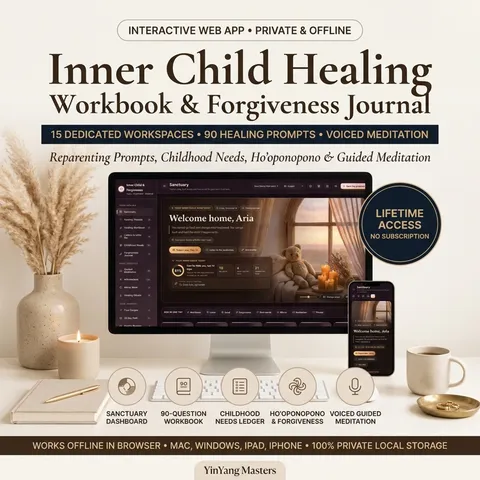
Gently reparent the child you were. Answer 90 healing questions, write letters to little you, meet your childhood needs and practice forgiveness with a guided meditation.
A starter shadow work journal for your first 30 days: log what sets you off, map the parts of you that react, and write through twelve guiding questions.
Every hour Moon Keeper reads the sky, draws one tarot card and shares a calm 3-minute reflection. Drop by the altar, follow the hourly diary and leave a note in the guestbook.
One short email a day: a practice for today, a real reader story, and the newest guide on love, money and inner calm.
For more than 8 years, a community of over 2,400,000 followers and 38,000+ students has shared how these daily practices helped in love, money and inner calm.