A shadow work tarot spread lays out five structured card positions—surface trigger, protective story, projected mirror, unmet need, and one grounded step—to turn emotional blind spots into concrete questions. Rooted in Carl Jung's concept of the psychological shadow, this reflective pull examines everyday reactions calmly in ten minutes without fatalistic fortune-telling.
Interactive Practice
Loading tool...
Follow this reading through the whole year👥 38k+ students
Enter your birthday to see your 2027 Personal Year and the angel number for each month, with space to write your intentions.
Interactive Practice Web App · Full Edition14 modules
Shadow Work Journal & Sound Healing Guide
You learn what really triggers you and which tools calm you down fastest, laid out on a simple weekly chart.
Web app for phone or laptop. Log triggers, answer shadow work prompts and play the listening deck. No birth date needed.
👥 38k+ students👥 38,000+ students · 2.4M+ community
$27.99$20.99$27.99₫609,000₫456,000₫609,000
Step 1 · Tap the struggle that stops you most:
How this app solves it for you
A trigger log captures what set you off and what eased it, so the pattern finally loosens its grip.
Included inside: Themes gather every entry about the reactions and fears you keep returning to, so you finally see the pattern instead of isolated bad days.
Step 2 · Inspect real app screens inside
Healing Overview
14 modules · 2 live trial tabs
Organized command view tracking active shadow themes, emotional patterns, and ready-to-open guided tabs.
Pay once · Lifetime access · Instant email delivery
Yes. Shadow Work Journal & Sound Healing Guide — Inner Healing, Trigger Log & Solfeggio Frequencies is built for this: Log each trigger with the body sensation, strength before and after (0-10) and the tool you used.
Enter your birthday to see your 2027 Personal Year and the angel number for each month, with space to write your intentions.
A shadow work tarot spread lays out five structured card positions—surface trigger, protective story, projected mirror, unmet need, and one grounded step—to turn emotional blind spots into concrete questions. Rooted in Carl Jung's concept of the psychological shadow, this reflective pull examines everyday reactions calmly in ten minutes without fatalistic fortune-telling.
Many people pull tarot cards looking for reassurance about another person's choices and end up more anxious than when they shuffled the deck. Anchoring each card pull inside our shadow work for beginners somatic integration guide turns symbolic imagery back into steady self-observation, helping you notice nervous-system activation before jumping to conclusions.
Reflection Disclaimer: Shadow work and tarot spreads serve strictly as structured prompts for personal reflection, emotional pattern awareness, and mindful pacing. Tarot imagery does not predict fixed outcomes, diagnose conditions, or substitute for licensed medical, psychiatric, or psychological care.
5-Card Shadow Work Tarot Spread: Positions & Reading Layout
This 5-card shadow work tarot spread takes ten minutes from shuffle to written takeaway using five distinct positions. Each slot isolates one layer of an emotional reaction—body trigger, defensive narrative, interpersonal mirror, underlying need, and immediate physical action—so intense feelings become organized inquiry.
In analytical psychology pioneered by Carl Jung, the psychological shadow holds traits, impulses, and vulnerabilities you learned to hide so you could stay accepted early in life. Rather than summoning external mysteries, a structured spread simply uses visual metaphors to ask direct questions you normally skip during a busy day. If you have ever worried about esoteric myths around inner inquiry, our companion guide answering is shadow work demonic or grounded psychology explains how Jungian reflection stays practical and safe.
Lay the cards out left to right—or draw cards directly inside the interactive reading sanctuary above—and move through the five positions in strict order:
Card Position
Psychological Lens
Direct Tarot Inquiry Question
2-Minute Written Output
Card 1: The Surface Trigger
Autonomic reactivity & daily friction
What exact situation, tone, or boundary crossing activated my stress response this week?
Name the specific event in 15 plain words without blaming or mind-reading.
Card 2: The Hidden Protective Story
Learned defense & early rulebook
Which old belief about safety, approval, or rejection am I defending right now?
Write the unspoken rule starting with "If I don't..., then I will lose..."
Card 3: The Projected Mirror
Unowned trait reflected in others
What quality I resent or envy in someone else is pointing toward a part of me asking for air?
Identify one disowned trait—such as directness, rest, or ambition—behind the reaction.
Card 4: The Unmet Core Need
Emotional vulnerability underneath armor
What genuine human need—clear limits, reassurance, rest, or honesty—went unspoken here?
State the plain need in one neutral sentence addressed to yourself.
Card 5: One Grounded Integration Step
Behavioral agency & somatic pacing
What single realistic habit can I practice within 24 hours to honor this insight calmly?
Choose one measurable 5-minute action for today's schedule.
Keeping all five cards anchored to real situations from the past seven days prevents the mind from drifting into abstract speculation. Even if two cards look contrasting on the table, treat the contrast as nuance—showing both the armor you wear in public and the quiet need asking for attention underneath.
How to Read Shadow Work Tarot Cards Without Fear or Fatalism
Reading shadow work tarot cards accurately requires replacing fortune-telling panic with a 4-step reflective sequence across the 78-card deck. Instead of treating dramatic artwork as an unavoidable omen, view each card through psychological projection to ask what habit or tension the symbol mirrors in your current week.
Historically, tarot decks evolved from fifteenth-century European card games into rich visual libraries of human dilemmas, ambition, grief, and renewal. Because your mind naturally projects unfinished concerns onto ambiguous images, cards with stark illustrations—like The Tower, The Devil, or Nine of Swords—act like inkblots that reveal where you feel trapped or guarded today. Pair card notes with structured prompts in our self reflection journal prompts guide and learn to separate quiet inner cues from anxious urgency in our breakdown of daily intuition journal tracking.
Describe What Your Eyes Notice First (30 Seconds): Before opening a reference booklet, note the first physical detail in the card's posture, color contrast, or expression—whether the figure looks frozen, turning away, or holding tight to coins or swords. That immediate reaction exposes your nervous system's current bias.
Translate Dramatic Symbols Into Behavioral Patterns (60 Seconds): Reframe ominous names as everyday habits. Reversed swords point to unexpressed frustration turned inward; pentacles clung tightly to the chest point to scarcity guarding; chalices turned upside down point to emotional fatigue.
Separate Fact From Narrative Distortion (60 Seconds): Ask two grounding questions: "Where have I already lived a milder version of this pattern in the past 14 days?" and "What objective evidence confirms or disproves the story my fear is telling?"
Log Strength Before and After Reflection (60 Seconds): Rate the trigger intensity on a 0-to-10 scale before writing and again once you finish naming the card's reframe so you track real emotional down-regulation over time.
Tarot Card
Common Surface Fear
Shadow Work Reframe Question
2-Minute Grounded Check
The Devil (XV)
Feeling cursed or powerless
Where am I trading long-term self-respect for short-term validation or avoidance?
Name one loose chain—a habit you maintain out of habit rather than actual force.
The Tower (XVI)
Sudden external disaster
Which fragile expectation or unspoken boundary have I delayed confronting until pressure built?
Write down one honest conversation or schedule change you keep postponing.
The Moon (XVIII)
Deception and confusion
What ambiguity is my nervous system filling in with worst-case assumptions right now?
Separate three known facts from three untested assumptions in two columns.
Death (XIII)
Permanent loss
Which outdated role, people-pleasing identity, or overcommitment is overdue for clean closure?
Identify one draining task or obligation you can retire this week.
Nine of Swords
Spiraling regret at night
Which unspoken self-criticism loops loudest when distractions stop at bedtime?
Write the harsh thought down verbatim, then answer it in the voice of a fair friend.
Five of Pentacles
Scarcity or being left out
Where am I refusing available support out of pride or assuming nobody wants to help?
List two practical resources or supportive people already within reach today.
When a challenging card lands in your spread, resist shuffling again to pull a "better" card. Staying with the uncomfortable card for two minutes—and writing down one clear fact about why it stung—builds far greater emotional resilience than chasing reassuring pulls.
To keep card insights tied to recurring triggers instead of scattered notebooks, the Shadow Work Journal & Sound Healing Guide connects Themes, a Shadow Map showing what sets each part off alongside its old story and hidden gift, a Trigger Log measuring body sensation and 0-to-10 strength before and after each tool, twelve guiding writing questions, plus a listening deck with two original instrumental tracks in 432 Hz and 528 Hz tunings.
3-Card vs. 5-Card Spreads and Choosing a Shadow Work Tarot Deck
Choosing between a 3-card check-in (five minutes) and a 5-card shadow work tarot spread (fifteen minutes) depends directly on how much nervous-system bandwidth you have today. Matching spread size and deck artwork clarity to your current energy prevents emotional flooding and keeps reflection consistent week after week.
Many readers stall before pulling a single card because they assume shadow work requires a dark, gothic deck with specialized keywords printed across every border. In practice, traditional 78-card Rider-Waite-Smith imagery—with clear human gestures, landscapes, and everyday objects—offers much richer psychological cues for beginners than minimalist abstract decks. Compare your daily options cleanly in the table below:
Spread Format
Cards & Time Window
Best Weekly Use Case
Nervous System Load
Recommended Logging Focus
1-Card Micro Trigger Pull
1 card · 3 minutes
Midday reset right after a tense call or email
Low (gentle grounding)
Name body sensation + 1-line reframe
3-Card Quick Shadow Check
3 cards · 5 to 7 minutes
Evening review: Trigger → Hidden Rule → Next Step
Low to Moderate
Log reaction score 0–10 before & after
5-Card Shadow Work Tarot Spread
5 cards · 10 to 15 minutes
Weekly deep dive into recurring conflict or projection
Moderate (requires somatic reset)
Map trigger, old story, need & 24-hour action
10-Card Celtic Cross (Cautioned)
10 cards · 30+ minutes
Broad life-chapter mapping for seasoned readers
High (often causes overwhelm)
Avoid when actively triggered or fatigued
When choosing a physical or digital deck for shadow inquiry, prioritize legibility over moodiness. Look for crisp scenes showing facial expressions and interaction between figures, test whether you can hold the cards comfortably during a quiet morning sit, and remember that you can pull cards immediately with the interactive deck on this page without buying new cards first. If you want an offline browser alternative to paper notebooks, see our comparison of what makes a shadow work journal app genuinely private and useful, and explore how early childhood roles shape adult reactions in our 5-step daily guide to reparenting your inner child.
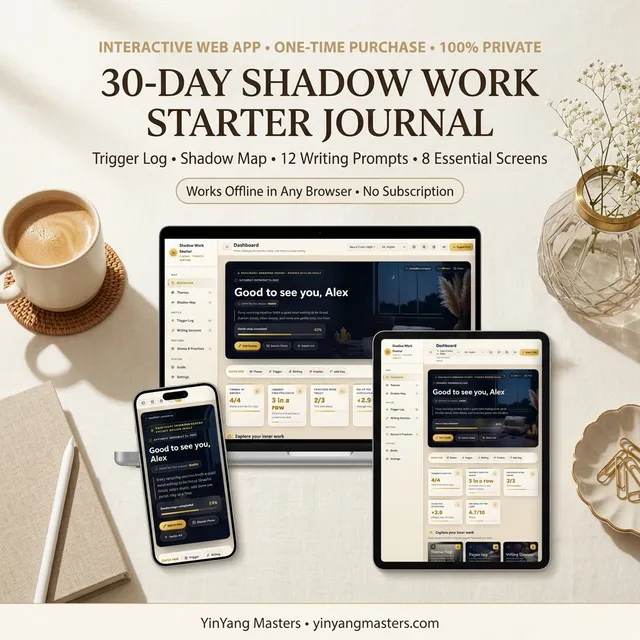
For your first month building steady reflection without extra audio or complex rituals, the 30-Day Shadow Work Starter Journal streamlines the core workspace into 8 focused screens—including Themes, Trigger Log with an 8-week trend chart, Shadow Map, twelve writing prompts across six categories, and daily practice chains—with no music player included so you can finish in three quiet minutes a day.
30-Second Somatic Reset and 10-Minute Tarot Shadow Log
Running a 30-second somatic reset before pulling your first card calms autonomic vigilance so reflection stays honest across a 10-minute writing window. By pairing two physiological breaths with a 0-to-10 reaction rating, you measure genuine nervous-system settling rather than spiraling into mental analysis.
Stepping through a 30-second somatic reset before logging five card insights inside a strict 10-minute timer prevents emotional overload.
Step 1: The 30-Second Somatic Reset Before Pulling Your First Card
Before touching the deck or typing into the interactive spread tool, down-regulate your sympathetic nervous system out of defensive urgency. Spend 30 seconds on a physiological sigh: inhale steadily through your nose until your lungs feel full, take one short second sip of air through your nose at the top to reopen tiny lung alveoli, then release a slow, unhurried six-second exhale through softly parted lips. Complete the reset with quiet somatic orienting by noticing three solid physical supports around you—both feet resting flat on the floor, your lower back supported by the chair, and your forearms resting comfortably on the desk. Once your shoulders drop half an inch, your mind can observe tender tarot themes with curiosity instead of panic.
Step 2: The 10-Minute Shadow Tarot Container
Set a 10-minute timer on your desk clock before turning over card one so shadow inquiry has a clear start and finish line:
Minutes 1–2 — Draw, Breathe, and Note Body Sensation: Pull your 3 or 5 cards cleanly, record your initial trigger strength from 0 to 10, and jot down one physical sensation (tight jaw, shallow breath, warm face) before reading card keywords.
Minutes 3–5 — Write One Plain Observation Per Position: Answer each position prompt from the spread table in one to two direct sentences. Stick to observable behavior from this past week instead of guessing someone else's hidden motives.
Minutes 6–8 — Name the Protective Habit and Unmet Need: Summarize what your defense was trying to protect—safety, belonging, predictability, or rest—and acknowledge the underlying need without scolding yourself for having it.
Minutes 9–10 — Close With One Tangible Action and Re-Rate Intensity: Write down one concrete 5-minute step for tomorrow, log your post-reflection trigger score from 0 to 10, drink a glass of water, and step into an ordinary grounded activity like tidying your desk or walking outside.
When your tarot pulls repeatedly surface older family rules—such as feeling invisible, walking on eggshells, or earning care through perfection—the Inner Child Healing Workbook & Forgiveness Journal offers 15 connected offline spaces including a 4-stage 90-question workbook, a Childhood Needs Ledger across eight core emotional needs, Letters to Little Me with photo cards, a Forgiveness Journal with a Ho'oponopono phrase counter, and a three-part voiced guided meditation. Returning steadily to calm self-honesty turns every future spread into practical clarity you can act on immediately.
Apply it now
Put this article into practice
For more than 8 years, a community of over 2,400,000 followers and 38,000+ students has shared how these daily practices helped in love, money and inner calm.
Understand your reactions and gently heal old patterns. Name the themes you keep circling, map each shadow part, log what sets you off and discover what truly helps you calm down.
For more than 8 years, a community of over 2,400,000 followers and 38,000+ students has shared how these daily practices helped in love, money and inner calm.
Every hour Moon Keeper reads the sky, draws one tarot card and shares a calm 3-minute reflection. Drop by the altar, follow the hourly diary and leave a note in the guestbook.
One short email a day: a practice for today, a real reader story, and the newest guide on love, money and inner calm.
For more than 8 years, a community of over 2,400,000 followers and 38,000+ students has shared how these daily practices helped in love, money and inner calm.
$27.99$20.99$27.99₫609,000₫456,000₫609,000🔥 Save 25%🔥 Save 25%
Spread
Draw a tarot spread
Pick a spread, think of your question, then draw. One card gives a quick answer, three cards show past, present and future, and the Celtic Cross looks at the whole situation.
Your tarot journal
Your tarot journal
Your tarot journal: save a spread you want to come back to, add notes, and search past readings. Kept only on this device.
No saved readings in this view. Draw cards to start your reflective journal.