Learning how to reparent your inner child means intentionally giving yourself the emotional safety, clear boundaries, steady discipline, and healthy play that early caregivers could not consistently offer. Instead of waiting for external rescue, ten minutes of somatic grounding and written two-hand dialogue daily builds adult self-trust.
Try it right here
Loading tool...
Keep writing what you just started★★★★★ 4.9 · 38k+ students
Enter your birthday to see your 2027 Personal Year and the angel number for each month, with space to write your intentions.
Quick answers
Yes. Shadow Work Journal & Sound Healing Guide — Inner Healing, Trigger Log & Solfeggio Frequencies is built for this: Log each trigger with the body sensation, strength before and after (0-10) and the tool you used.
How to Reparent Your Inner Child: A 5-Step Daily Practice for Emotional Safety and Self-Trust
Learning how to reparent your inner child means intentionally giving yourself the emotional safety, clear boundaries, steady discipline, and healthy play that early caregivers could not consistently offer. Instead of waiting for someone else to soothe old triggers, ten minutes of somatic grounding and written two-hand dialogue daily builds adult self-trust.
Real transformation happens when comforting words turn into repeatable structure rather than one emotional night of tears. Before starting the daily prompts below, read our inner child healing and forgiveness workbook guide to see how ordinary adults tracked calmer inner voices across several weeks.
Reflection Disclaimer: Self-reparenting and expressive journaling are personal reflection practices for adult emotional awareness and daily steadiness. They do not diagnose or treat trauma, anxiety, or depression, and are not a substitute for licensed therapy or medical care.
How to Reparent Your Inner Child: What Self-Parenting Really Means
In psychology, reparenting is a conscious adult habit where your grounded present self steps in to protect, validate, and guide the inner child—your stored emotional memory of unmet needs. Practicing for just 10 minutes per day over 21 days helps interrupt automatic shame loops faster than unguided overthinking.
Most adults assume healing childhood gaps means endlessly analyzing past mistakes or blaming caregivers. In practice, self-parenting works from the inside out: whenever an ordinary adult moment sets off a sharp, outsized reaction, you recognize that a younger protective part has taken the wheel, soothe your nervous system first, and respond with adult steadiness.
Four everyday signs usually show that an unparented part of you is asking for reliable internal leadership:
Disproportionate threat alarms in small moments: A delayed message, mild feedback, or changed weekend plan sparks a 7-out-of-10 spike of panic, anger, or sudden shutdown that feels far older than today’s situation.
Chronic people-pleasing and fawning under stress: You say yes immediately to avoid disappointing anyone, then feel quietly resentful later because your child self still equates conflict with abandonment.
A relentless inner critic masquerading as discipline: Whenever you rest or make a minor error, an internal voice scolds you harshly instead of troubleshooting calmly like a patient mentor.
Alternating between rigidity and emotional exhaustion: You swing from hyper-independent overworking to abrupt burnout, struggling to ask for help, set clean limits, or allow low-stakes rest without guilt.
Recognizing those signals removes self-blame immediately: nothing is broken in your character. An outdated survival rule simply keeps running without an updated adult reassuring it, which you can explore gently alongside structured inner child healing journal prompts.
The Four Pillars of Reparenting Your Wounded Inner Child
Sustainable self-parenting rests on four balanced pillars—emotional safety, firm boundaries, gentle structure, and restorative play—rather than indulgence or harsh self-criticism. Grounding practice in Kristin Neff’s model of self-compassion balances warm validation with clear adult accountability so emotional regressions settle within 5 to 15 minutes.
When people struggle with ways to reparent a wounded inner child, they often lean entirely into soothing without structure, or discipline without warmth. Healthy caregiving requires holding both steadiness and tenderness at the same time:
Pillar 1 — Emotional Attunement & Co-Regulation: A steady parent does not tell a distressed child to calm down immediately or pretend pain is fine. Instead, you name the exact sensation in plain language—such as tight chest or fearful embarrassment—while keeping breathing slow so the younger state feels witnessed without taking over decision-making.
Pillar 2 — Protective Adult Boundaries: An unguarded child feels unsafe when every external demand gets immediate access to their energy. Reparenting means saying no cleanly to draining obligations, leaving toxic conversations earlier, and keeping written commitments with yourself so your younger part trusts that you will actually protect them.
Pillar 3 — Gentle Routine & Follow-Through: Neglect does not only look like harshness; chaos and broken promises also breed anxiety. Basic scaffolding—regular sleep hours, honest financial check-ins, tidy recovery windows after busy weeks, and finishing one small hard task before scrolling—signals predictable adult leadership.
Pillar 4 — Guilt-Free Curiosity & Restorative Play: Many wound patterns stem from growing up too fast, translating every hour into productivity or vigilance. Scheduling at least 30 minutes twice a week for unmonetized movement, sketching, music, or nature time teaches your nervous system that worth does not depend on constant usefulness.
Tracking eight core childhood needs—safety, being seen, comfort, play, praise, being heard, rest, and healthy limits—turns vague self-care slogans into measurable weekly check-ins rather than guesswork.
Inner Child Reparenting vs Shadow Work vs Traditional Worksheets: What Fits Best?
Choosing the right modality depends on whether you feel overwhelmed by vulnerability, defensive judgment toward others, or scattered insight without daily structure. Research on polyvagal autonomic regulation shows that matching inquiry depth to current nervous-system capacity reduces emotional flooding more reliably than forcing intense catharsis through random PDFs.
Readers often wonder whether they need another book, loose printable worksheets, shadow prompts, or an integrated guided workbook. Comparing four common approaches side by side clarifies which tool solves which bottleneck:
Approach
Primary Mechanism
Best Trigger State
Typical Daily Commitment
Main Limitation to Watch
Daily Two-Hand Reparenting Dialogue
Present-tense written conversation between protective adult and younger emotional state
Can feel overly analytical unless paired with compassionate soothing for the hurt child underneath
Loose Printable PDF Worksheets
Single-session fill-in prompts on childhood memories and affirmation checklists
Quick awareness audit or a first structured weekend reflection
One 20–45 minute sitting
Pages get lost quickly; zero longitudinal tracking of weekly needs met or mood shifts
Self-Help Psychology Books
Narrative theory, clinical case stories, and developmental frameworks
Building conceptual vocabulary and realizing reactions are normal
20–30 minutes of reading
Insight stays purely cognitive without a daily space to practice and log behavioral follow-through
Whenever heavy anger, envy, or sudden social projection dominates your week alongside childhood hurt, pairing reparenting with our Carl Jung shadow work and inner child healing guide helps map both the defensive mask and the tender need underneath. If you prefer keeping private reflections off scattered paper pads, compare calm offline options in our guide to a dedicated shadow work journal app or explore our roundup of the best journal apps for daily reflection.
The 5-Step Daily Protocol to Reparent Your Inner Child
A consistent daily reparenting routine takes roughly 10 to 12 minutes in the evening, splitting 30 seconds for nervous-system settling and 9 minutes for focused written dialogue and concrete action. Measuring your internal safety on a simple 1-to-10 before-and-after scale makes emotional progress observable within 2 to 4 weeks without relying on dramatic breakthroughs.
Ten unhurried minutes with one warm ritual turns abstract self-compassion concepts into lived daily safety.
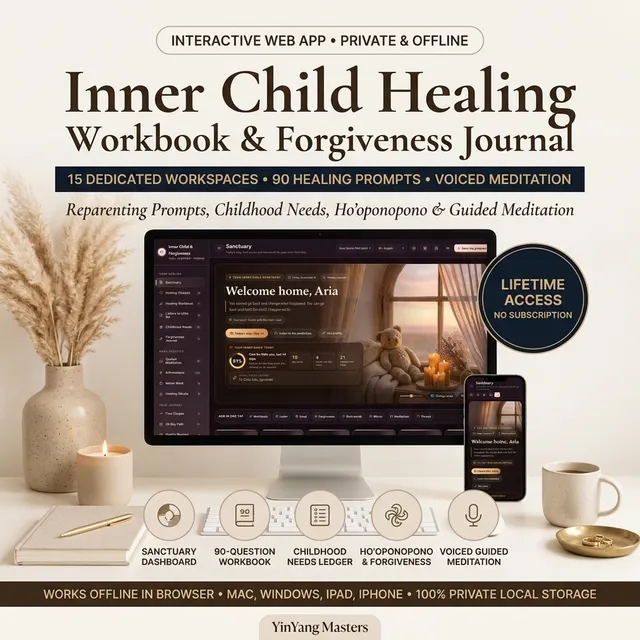
If you want every piece held together instead of hunting through loose folders, the Inner Child Healing Workbook & Forgiveness Journal connects a 14-day Sanctuary care ring with 90 sequential questions across four stages—Recognize, Embrace, Reparent, and Forgive. Inside the same private space, Letters to Little Me lets you pair a childhood photo with gentle prompts, a childhood needs log tracks eight daily needs, the forgiveness journal includes counters for the four Ho’oponopono phrases plus a clear boundary line, and the 12-minute voiced meditation Coming Home to Little You helps heavy evenings settle cleanly.
When recurring relational triggers also trace back to protective masks—such as over-controlling outcomes or swallowing frustration—the Shadow Work & Sound Healing Journal helps name each triggered part by what set it off, its old childhood rule, the unmet need underneath, and its healthy gift across twelve guided questions with before-and-after somatic calm ratings.
Before You Write: The 30-Second Somatic Reset
Never begin reparenting dialogue while your heart is racing or your inner critic feels loud enough to hijack the page. First, spend 30 seconds physically settling your system: run two physiological sighs—inhale steadily through your nose, add a quick second sniff at the top to expand tight lungs, and let a slow six-second exhale flow softly through relaxed lips—then perform quiet somatic orienting by silently naming three ordinary textures, colors, or objects in the room until your shoulders drop.
Once your breathing feels settled, follow this repeatable five-step daily sequence for at least fourteen consecutive days:
Step 1 — Anchor One Trigger & Name the Estimated Age (Minutes 1–2): Write one specific moment from the last 24 hours where your chest tightened, your throat closed, or you felt an urge to shrink or snap. Without judging yourself, estimate how old that reaction feels—often five, eight, or twelve—and rate present bodily tension from 1 to 10.
Step 2 — Ask Directly From Your Dominant Hand, Answer Gently From Your Opposite Hand (Minutes 3–6): With your dominant writing hand, ask a short supportive question such as, "Little me, what scared or hurt you most about that moment today, and what did you secretly want someone to say?" Then switch hands—or write slowly in softer print if physical switching feels distracting—and allow simple, blunt phrases to appear without editing grammar or sounding "mature."
Step 3 — Deliver Adult Validation Plus One Clean Boundary Statement (Minutes 7–8): Switch back to your dominant adult voice and validate the feeling without adopting the child’s panic: write "It makes complete sense that eight-year-old you felt invisible there; that was real. Today, however, I am an adult, I am staying with you, and we do not have to chase approval from unsafe rooms."
Step 4 — Meet One of the Eight Core Needs With an Observable Action (Minutes 9–10): Pick one concrete, tiny action inside the next two hours that proves you mean what you wrote—drinking water and sleeping on time (rest), declining an unnecessary favor (healthy limits), taking a fifteen-minute unscheduled walk (play), or speaking aloud one genuine appreciation (praise) generated with a tool like our daily affirmation generator.
Step 5 — Separate Forgiveness From Reconciliation When Old Hurt Surfaces (Optional Weekly Layer): When anger toward an early caregiver keeps looping, release the emotional debt for your own peace without confusing release with renewed access. Pair an honest boundary statement with our Ho’oponopono Hawaiian forgiveness practice guide and re-score your calm rating from 1 to 10 after closing the notebook.
Consistency outweighs intensity every single week: treating small promises to yourself as sacred teaches your nervous system that someone steady is finally in charge, building an emotionally grounded abundance mindset rooted in genuine self-trust rather than anxious performance.
FREE INTERACTIVE GUIDE
Get Your Free 2027 Angel Number Year Map
Enter your birthday to reveal your 2027 Personal Year, the angel number guiding each month, and a private workspace to set your intentions.
Apply it now
Put this article into practice
For more than 8 years, a community of over 2,400,000 followers and 38,000+ students has shared how these daily practices helped in love, money and inner calm.
Wind down with 528 Hz without hunting through ad-filled videos. You get a solfeggio chart from 396 to 963 Hz that explains each tone, plus soft original music in 432 Hz and 528 Hz that is yours to keep. It is a relaxation practice, not medical care.
For more than 8 years, a community of over 2,400,000 followers and 38,000+ students has shared how these daily practices helped in love, money and inner calm.
Every hour Moon Keeper reads the sky, draws one tarot card and shares a calm 3-minute reflection. Drop by the altar, follow the hourly diary and leave a note in the guestbook.
One short email a day: a practice for today, a real reader story, and the newest guide on love, money and inner calm.
For more than 8 years, a community of over 2,400,000 followers and 38,000+ students has shared how these daily practices helped in love, money and inner calm.