



The Rule of 3 Focus for UI/UX Designer: Complete Professional Workflow & Implementation Guide
Why it matters
1. Operational Friction and Cognitive Workload Reality for UI/UX Designers
UI/UX Designers face relentless cognitive fragmentation without clear framework boundaries.
The Rule of 3 imposes a rigorous cognitive ceiling on daily ambitions, distilling boundless professional obligations into exactly three definitive, high-impact victories.
In the high-pressure realm of the UI/UX Designer, an infinite task backlog creates chronic anxiety. Trying to advance everything simultaneously—from architecting end-to-end interactive onboarding user journeys in Figma to secondary demands like standardizing component design tokens across dark and light modes—causes visual-spatial fatigue and aesthetic burnout from continuously adjusting micro-interactions, responsive grid constraints, and Figma auto-layouts, resulting in mediocre half-measures across all fronts.
default
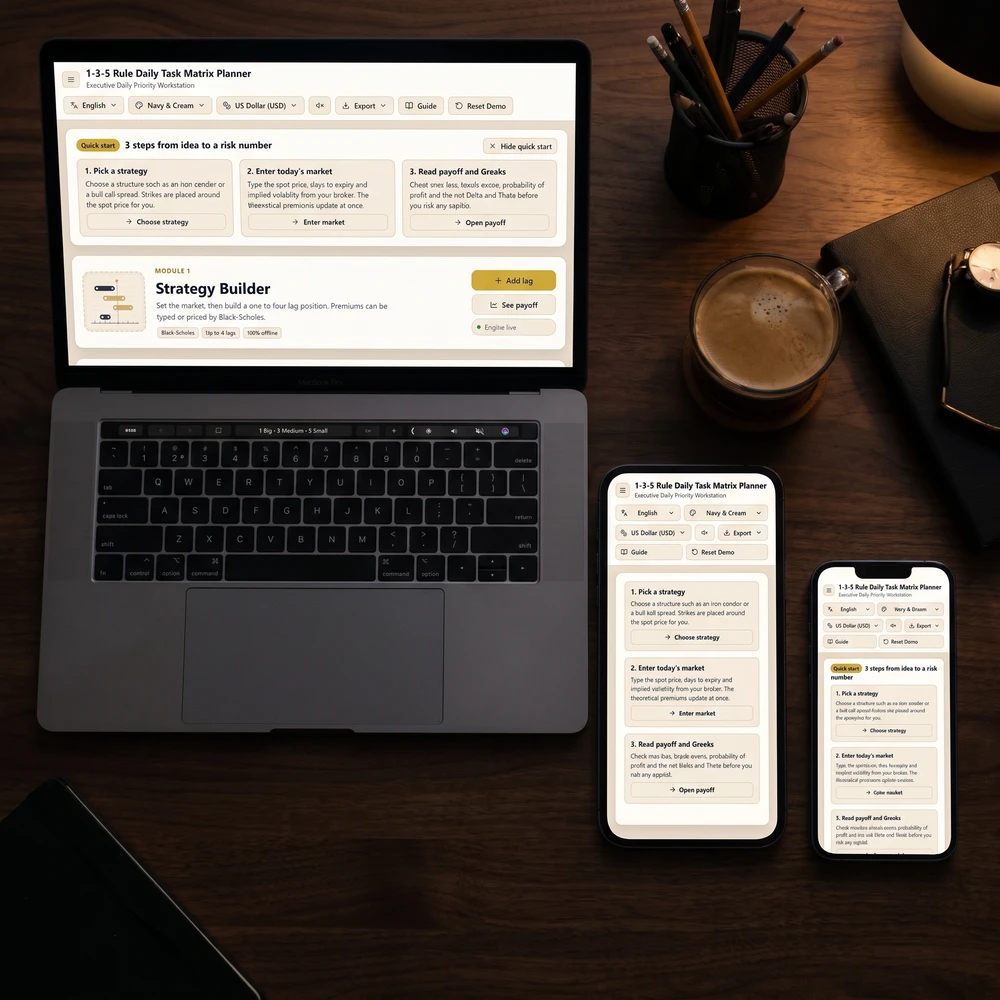
The inline interactive trial version is currently being deployed. You can access the full functional edition through the companion tool below.
How it works
2. Cognitive Mechanics and Framework Architecture
Understanding attentional switching costs enables UI/UX Designers to protect executive bandwidth.
Working memory research demonstrates that human neural bandwidth degrades exponentially when attempting to track more than three to four complex goals concurrently.
Restricting daily targets to exactly three finished outcomes aligns with human working memory limits. For a UI/UX Designer, this mental constraint prevents cognitive dilution, marshaling total cognitive capacity behind the decisive completion of architecting end-to-end interactive onboarding user journeys in Figma.
How to practice
3. Role-Specific Implementation Protocol and Daily Schedule
A structured daily sequence aligns The Rule of 3 Focus with real-world UI/UX Designer deliverables.
Write your three daily outcomes on a tangible physical index card placed flat directly beneath your keyboard, serving as an immutable visual anchor throughout the day.
Daily schedule for a UI/UX Designer: Write your three daily victories on an index card: Target 1 is completing a major milestone on architecting end-to-end interactive onboarding user journeys in Figma, Target 2 is advancing collaborative deliverables like standardizing component design tokens across dark and light modes, and Target 3 is resolving operational tasks like conducting usability testing sessions to eliminate friction in core transactional funnels. Defend these three outcomes against all incoming noise.
How it compares
4. Resolving Industry Trade-offs, Edge Cases & Cognitive Traps
Establishing clear triage protocols resolves unpredictable industry emergencies without breaking the framework.
The dangerous trap is treating the three selected items as a flexible baseline and continually permitting secondary wishlist tasks to siphon attention away from core completion.
When industry crises like unplanned marketing asset fire drills, last-minute product requirements alterations, or conflicting subjective design critiques emerge, ask whether this event invalidates your three core daily commitments. Apply disciplined triage (routing ad-hoc asset requests into an asynchronous review inbox while defending dedicated prototyping blocks from subjective stakeholder interference) before renegotiating your triad.
Putting it together
5. Long-Term Career Mastery and Sustainable High Performance
Sustained mastery elevates professional output into enduring, compounding career capital.
Achieving three high-impact outcomes every day yields more than seven hundred strategic victories annually for the UI/UX Designer. This compounding execution velocity produces magnificent intuitive user flow architectures and unified design token systems, cementing your standing as a distinguished design director whose cohesive product design systems and intuitive user journeys set global industry benchmarks.
Key insights
Framework Archetype: The Rule of 3 Focus tailored for UI/UX Designer.
Neurological Lever: Working memory research demonstrates that human neural bandwidth degrades exponentially when attempting to track more than three to four complex goals concurrently.
Somatic Key: Cultivating disciplined cognitive boundaries when executing architecting end-to-end interactive onboarding user journeys in Figma without attention fragmentation.
Try this now
- 1
Establish morning focus container dedicated exclusively to architecting end-to-end interactive onboarding user journeys in Figma.
- 2
Implement framework protocol: Write your three daily outcomes on a tangible physical index card placed flat directly beneath your keyboard, serving as an immutable visual anchor throughout the day.
- 3
Apply tactical triage protocol: routing ad-hoc asset requests into an asynchronous review inbox while defending dedicated prototyping blocks from subjective stakeholder interference.
Practices to build in
Morning deep work block dedicated exclusively to architecting end-to-end interactive onboarding user journeys in Figma.
Midday collaborative coordination window handling standardizing component design tokens across dark and light modes.
Afternoon administrative buffer resolving conducting usability testing sessions to eliminate friction in core transactional funnels.
From the blog
Latest articles




Digital planners & toolkits
Ready-made systems for your next goal
Interactive planners and journals that open in your browser, on phone or laptop.




Most popular
What shoppers search for most
Ranked by what people searched on Google over the last 4 weeks.


Go deeper
Guides on this topic


Keep exploring
More from Yin Yang Masters




Get Your Free 2027 Angel Number Year Map
Enter your birthday to reveal your 2027 Personal Year, the angel number guiding each month, and a private workspace to set your intentions.
More in this series
Pomodoro Technique for UI/UX Designer: Complete Professional Workflow & Implementation Guide
Eisenhower Priority Matrix for UI/UX Designer: Complete Professional Workflow & Implementation Guide
Time Blocking & Calendar Defense for UI/UX Designer: Complete Professional Workflow & Implementation Guide
Getting Things Done (GTD) for UI/UX Designer: Complete Professional Workflow & Implementation Guide
Eat That Frog First for UI/UX Designer: Complete Professional Workflow & Implementation Guide
The Rule of 3 Focus for Software Engineer: Complete Professional Workflow & Implementation Guide
Common questions
During peak intensity phases like design system engineering handoff milestones and critical product launch UX reviews, narrow your execution scope exclusively to architecting end-to-end interactive onboarding user journeys in Figma and strictly defer secondary administrative communication into designated end-of-day buffer periods.
Sources
Scholarly, traditional and cross-checked references used for this guide.

Turn what you just read into a daily practice
Printable and interactive planners built on these guides: moon rituals, manifestation scripting, habit and focus systems. Instant download, yours to keep.