To learn how to habit stack, anchor a new desired micro-behavior onto an established daily routine using the formula: "After [current habit], I will [new habit]." By attaching unfamiliar behaviors to automated neural circuits like brewing morning coffee, you eliminate cognitive friction, bypass willpower fatigue, and establish lasting behavioral chains.
How to Habit Stack: Step-by-Step Behavioral Guide and Routine Design

Jennie Uyen Chu
意识与能量专家

本文目前仅有越南语版本,中文版正在翻译中。
互动实践数字系统 · 完整版13 个模块
习惯追踪器与连续打卡规划本
一旦连续两天没打卡就会提醒你,让连续记录坚持得更久,还能一眼看到每个习惯的完成率。
网页应用,手机或电脑都能用。每天为每个习惯打卡,连续天数、习惯叠加与挑战自动更新。无需填写出生日期。
👥 3.8万+学员👥 38,000+ 学员 · 240万+ 社群
US$27.99US$20.99US$27.99₫729,000₫546,000₫729,000第 1 步 · 点击你平时最容易半途而废的痛点:
这套应用如何帮你彻底解决
习惯链把新习惯接在你已经在做的事后面,靠日常惯性而不是意志力。
内含对应工具: 每日打卡配周格和月视图,错过后第二天早上提醒你,在习惯淡掉之前把你拉回来。
第 2 步 · 直观查看应用真实模块界面
习惯实验室总览
13 个模块 · 2 个免费试用标签页清晰显示当日完成脉搏、连续天数列阵与一键打卡面板,保持稳健节奏。
一次买断 · 终身可用 · 付款后即刻发送至邮箱

免费领取 2027 天使数字年度地图
通过邮件领取《2027 天使数字年度地图》,内附 2027 个人年速查、每个月的天使数字与全年意图书写空间。
Most personal development initiatives collapse not from an absence of ambition, but from an architectural defect in behavioral design. Attempting to build demanding new disciplines from scratch creates friction in the prefrontal cortex, forcing the conscious brain to expend precious metabolic energy on basic decisions. By mastering the principles outlined in the Atomic Habits habit stacking framework, you can harness pre-existing cognitive momentum to make progressive daily upgrades virtually effortless.
How to Habit Stack: The Core Behavioral Formula and Implementation Intentions
At its operational foundation, habit stacking is an advanced application of what behavioral psychologist Peter Gollwitzer termed implementation intentions. Classical self-improvement advice often instructs people to rely on abstract intentions, such as "I will exercise more often" or "I will read every day." Clinical research confirms that vague intentions rarely translate into somatic action because they lack an unambiguous environmental trigger.
When you specify the exact moment, physical location, and preceding cue for an action, your subconscious mind prepares the motor cortex in advance. James Clear adapted this principle into an elegant, scalable syntax that forms the bedrock of habit stacking:
The Golden Syntax of Habit Stacking
"After [CURRENT ESTABLISHED HABIT], I will [NEW MICRO-ACTION]."
The primary criterion for a successful stack is selecting an anchor habit that is non-negotiable and already executed with 100% daily reliability. Automated actions such as taking off your shoes when arriving home, pouring hot water into a mug, or closing your laptop at the end of the workday possess high synaptic stability. Hitchhiking a new habit onto these immovable anchors bypasses the need for emotional motivation. Similar to the principles of proactive mindset mastery discussed in our guide on the Bob Proctor goal card methodology, environmental clarity always outperforms sheer willpower.
Step-by-Step Guide: Designing Morning, Workday, and Evening Habit Chains
Constructing a resilient habit stack requires systematic progression through four sequential stages. Moving too quickly or stacking multiple high-friction habits simultaneously overloads cognitive bandwidth, triggering systemic drop-off within days. Follow this deliberate 4-step implementation protocol:
免费在线测算工具
生命灵数计算器
快速解答
有。习惯追踪器与连续打卡规划本 — 习惯叠加、75天挑战与专注重置正是为此设计:查看每个习惯的当前连续天数、最长纪录以及7天和30天完成率。
 习惯追踪器与连续打卡规划本 — 习惯叠加、75天挑战与专注重置查看交互式手册 →
- Audit Your Current Daily Anchors: Create a comprehensive list of fixed, involuntary physical events you complete each day from the moment your feet touch the floor. Categorize them by temporal window (morning awakening, work transition, dinner, pre-bedtime).
- Select an Ultra-Low Activation Habit: Choose one micro-habit that takes less than two minutes to perform. If your ultimate goal is reading 30 pages a day, scale the stacked habit down to opening your book to page one. Removing initial inertia is the single most critical variable in neural habit acquisition.
- Define Precise Environmental Placement: Specify where the physical items required for the habit reside. If your stack involves writing your daily priorities, place your dedicated journal directly atop your keyboard the evening before.
- Lock In a 14-Day Single-Stack Period: Commit to running exactly one new connection for two full weeks before adding a subsequent link. Stabilizing the first link ensures the neural bridge is mechanically sound before adding weight.

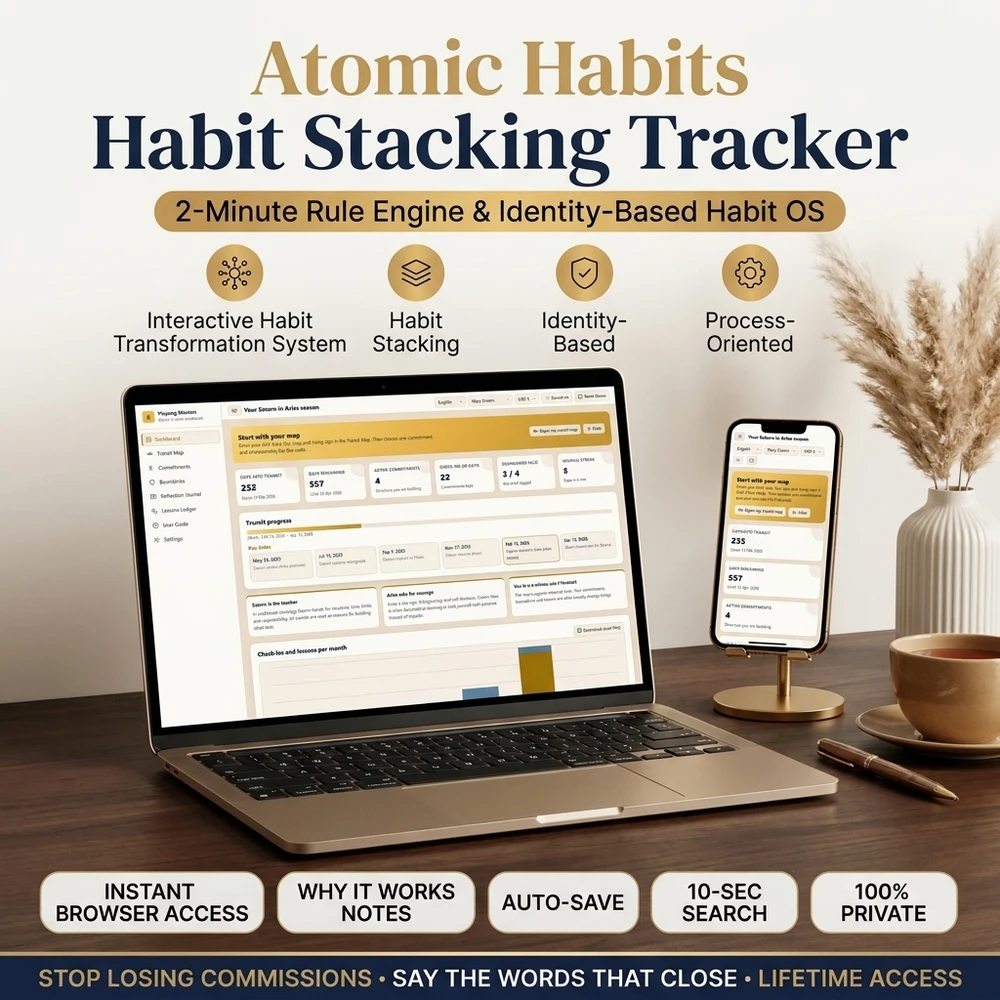
To visualize how high-leverage individuals structure their daily momentum, review the comprehensive behavioral matrix below. Incorporating dedicated tactile tools such as the Atomic Habits Habit Stacking Tracker allows you to visually log completion and build an unshakeable consistency streak.
| Daily Phase | Established Anchor Cue | Stacked Micro-Habit | Compound Behavioral Outcome |
|---|---|---|---|
| Morning Awakening | Turning off the bedside alarm clock | Drinking 16 ounces of mineral-rich water | Rapid cellular rehydration and metabolic activation |
| Deep Work Transition | Placing coffee mug onto the desk surface | Setting mobile devices to Airplane Mode | Elimination of cognitive switching costs and digital drift |
| Midday Physicality | Closing the laptop lid for lunch break | Performing 10 bodyweight squats or somatic stretching | Lymphatic circulation and postural tension release |
| Work Shutdown | Closing the primary email inbox tab | Recording top three priority targets for tomorrow | Mental closure preventing evening rumination (Zeigarnik effect) |
| Nocturnal Wind-Down | Connecting phone to charger outside bedroom | Reading two pages of contemplative literature | Melatonin synthesis and parasympathetic nervous activation |
The Cognitive Neuroscience of Habit Stacking: Synaptic Pruning and Basal Ganglia Encoding
To understand why habit stacking demonstrates such profound longevity compared to standard goal-setting methods, one must examine the neurological architecture of the mammalian brain. Every human action begins as an energy-intensive calculation in the prefrontal cortex—the region responsible for executive function, impulse inhibition, and conscious decision-making.
The brain represents merely 2% of total human body mass yet consumes over 20% of resting metabolic glucose. Because nature prioritizes energetic conservation for biological survival, the central nervous system seeks to automate any pattern of behavior that is repeated across identical temporal cues. Through a continuous neurodevelopmental process known as synaptic pruning, frequently traversed synaptic connections are reinforced with thick myelin sheaths, while neglected pathways are gradually degraded.
As an action becomes habitual, neurological control shifts from the volatile prefrontal cortex down into the basal ganglia—an ancient, primitive structure located deep near the brainstem. The basal ganglia processes motor memory and routine execution with minimal glucose expenditure. When you execute an anchor cue such as brushing your teeth or brewing morning coffee, your basal ganglia runs a deeply encoded "chunk" of automated motor code.
Habit stacking functions as a biological Trojan horse. Instead of demanding that your prefrontal cortex construct a brand-new, unmyelinated neural circuit through brute cognitive effort, habit stacking splices the new micro-behavior directly onto the terminus of an existing basal ganglia chunk. In behavioral terms, the established habit acts as a biological locomotive, pulling the new habit along its existing tracks. This physiological reality reinforces the philosophy examined in our review of Jocko Willink's discipline frameworks: true freedom originates from structured, automated self-mastery.
Habit Stacking vs. Temptation Bundling: Differences, Tradeoffs, and Strategic Combinations
While habit stacking focuses on structural sequence and environmental anchoring, another prominent behavioral architecture technique is temptation bundling, pioneered by behavioral economist Katy Milkman at the University of Pennsylvania. Understanding the tactical distinction between these two mechanisms enables you to deploy the proper framework for specific behavioral hurdles:
- Habit Stacking (Structural Sequencing): Pairs an established routine with a necessary new habit (e.g., "After I brew coffee, I will write down three priorities."). The psychological driver is environmental predictability and automated cues.
- Temptation Bundling (Dopaminergic Pairing): Pairs a high-discipline task with an immediate reward behavior (e.g., "I will only listen to my favorite true-crime audio show while walking on the treadmill."). The psychological driver is immediate anticipatory dopamine.
Rather than treating these methodologies as mutually exclusive, advanced habit designers engineer composite habit loops. In this combined structure, habit stacking provides the initiation trigger, while temptation bundling supplies the dopaminergic pull that sustains the session. For instance:
"After I sit down at my desk and open my task manager (Habit Stack), I will sip my favorite single-origin matcha tea while reviewing complex data (Temptation Bundle)."
Coupling these behavioral triggers with physical accountability instruments, like The 5 Second Rule Action Journal, provides the tactile feedback required to cement your compound routines across multi-month training phases.
Adapting Habit Stacking for ADHD: Overcoming Working Memory Lapses and Dopamine Dips
For neurodivergent individuals, particularly those navigating Attention-Deficit/Hyperactivity Disorder (ADHD), conventional habit advice frequently falls short. The neurotypical model of habit formation assumes a steady baseline of tonic dopamine and functional working memory. In the ADHD nervous system, dopamine transmission is characteristically dysregulated, and working memory buffers are prone to instantaneous disruption whenever external stimuli intervene.
When a person with ADHD attempts a standard five-step habit stack, an unexpected phone notification or a brief sensory distraction between step two and step three can completely dissolve the behavioral chain. To make habit stacking resilient against executive dysfunction, implement these three neurodivergent modifications:
1. Employ Multisensory Physical Anchors
Abstract mental triggers like "after I feel relaxed" do not exist for the ADHD brain. Anchors must be stark, tactile, and visible. Use bright physical items—such as placing a glass tumbler directly over your kitchen faucet—so the cue physically interrupts your physical path.
2. Enforce the Two-Step Chain Ceiling
Never attempt to build a linear stack exceeding two links (Anchor Cue + Micro Action) until the pair has operated flawlessly for 30 consecutive days. Long chains create catastrophic failure points where one missed link aborts the entire morning flow.
3. Create Immediate Somatic Closure
Because ADHD brains require acute dopamine feedback to validate completion, physically checking off a box on paper, ringing a small desk bell, or taking a deep sensory breath provides the immediate neurochemical reinforcement necessary to encode the basal ganglia loop.
By honoring your biological individuality and implementing intentional behavioral architecture, habit stacking transforms personal productivity from a grueling battle of willpower into a graceful, compounding rhythm of lifelong self-mastery.
同主题免费在线测算工具


马上实践
把这篇文章用起来
8多年来,超过240万名关注者和3.8万+名学员组成的社群,分享了坚持这些练习后在爱情、财富和内心平静上的真实变化。



参考来源与核验资料
- [1]Lally et al. (2010), How Are Habits Formed: Modelling Habit Formation in the Real World (European Journal of Social Psychology) ↗
- [2]Gollwitzer (1999), Implementation Intentions: Strong Effects of Simple Plans (American Psychologist) ↗
依据正念实操与个人成长编辑规范审校。 编辑政策
配套交互式手册与系统


真实故事
查看全部故事 →读者如何因这些练习而改变
8多年来,超过240万人的社群一直在用这套练习,3.8万+名学员也陆续分享了自己的结果。
 爱情故事
双生火焰日记有用吗?真实故事与每日练习
双生火焰日记真的有用吗?分享走出分手、迎来灵魂伴侣、找回平静的真实经历,并展示每天的练习在日记里是什么样子。
阅读指南 金钱故事
金钱显化日记有用吗?真实故事
金钱显化日记真的有用吗?分享还清欠款、争取加薪、缓解金钱焦虑的经历,并展示每天的练习在日记里是什么样子。
阅读指南
 爱情故事
分手后如何显化爱情:真实疗愈故事
分手后如何显化爱情?分享人们如何用自爱肯定语、照镜子练习和爱情日记先疗愈自己,再重新敞开心扉的真实经历。
阅读指南 金钱故事
显化无债生活:稳步还清欠款的真实故事
如何显化无债生活?分享人们如何把金钱肯定语、丰盛日记与清晰目标、截止日期和每日证据结合起来,稳步走向无债。
阅读指南 爱情故事
显化灵魂伴侣:从内在开始的真实故事
如何显化灵魂伴侣?分享人们如何写下理想伴侣脚本、制作爱情愿景板,并在爱到来之前先对生活说“好”。
阅读指南 金钱故事
显化加薪:自信开口的真实故事
如何显化加薪或升职?分享人们如何清理金钱信念、练习自信肯定语,并在开口前记录下自己的成绩。
阅读指南 爱情故事
双生火焰重逢故事:走向平静的真实旅程
真实的双生火焰重逢故事:人们如何借助旅程阶段、征兆记录和引导冥想,在分离期间找回平静,无论最终是否重逢。
阅读指南 金钱故事
从金钱焦虑到与钱和解:真实故事
分享缓解金钱焦虑的经历:查看账户前听一段简短的引导冥想,每周一次金钱约会,并温和地审视旧信念。
阅读指南
相关指南


更多文章



热门内容
本周读者最常打开的内容
按过去 7 天的真实访问量排序。




免费互动指南
免费领取 2027 天使数字年度地图
通过邮件领取《2027 天使数字年度地图》,内附 2027 个人年速查、每月指引天使数字与专属年度意图书写空间。
关注我们
每天的仪式,就在你的动态里
Yin Yang Masters 的简短指南、月相仪式和计划本使用教程。







在 AI 助手中直接询问 Yinyang Masters
在聊天中获得同样的计算与指引:添加免费的 Yinyang Masters 应用,然后用日常语言提问。无需注册账号。
试着问: “找一篇关于开始每日灵性练习的 Yinyang Masters 指南。”

正在直播
认识 Moon Keeper,我们的直播祭坛守护者
Moon Keeper 每小时观察星象、抽一张塔罗牌,并分享一段 3 分钟的静心练习。来祭坛看看,关注每小时日记,并在留言簿里写下你的话。

每日免费通讯
每天收到 Yin Yang Masters 通讯
每天一封简短邮件:一个今日练习、一个读者的真实故事,以及关于爱情、财富与内心平静的最新指南。
8多年来,超过240万名关注者和3.8万+名学员组成的社群,分享了坚持这些练习后在爱情、财富和内心平静上的真实变化。