




Skip to content
Yin Yang Masters

How to Make Manifestation Real: The Science-Backed WOOP Action Framework

Jennie Uyen ChuJennie Uyen Chu(Consciousness & Energy Expert)
Nov 8, 2026

Direct Answer Takeaway

To understand how to make manifestation real, you must shift from passive visualization to empirical mental contrasting: pairing a clear wish with identified internal obstacles through a 15-minute daily WOOP protocol. This structured cognitive sequence recalibrates your reticular activating system (RAS) and lowers somatic anxiety, converting abstract desire into measurable behavioral execution.

How to Make Manifestation Real: The Science-Backed WOOP Action Framework

To understand how to make manifestation real, you must shift from passive visualization to empirical mental contrasting: pairing a clear wish with identified internal obstacles through a 15-minute daily WOOP protocol. This structured cognitive sequence recalibrates your reticular activating system (RAS) and lowers somatic anxiety, converting abstract desire into measurable behavioral execution.

While popular culture insists that positive thoughts alone compel the universe to deliver outcomes, rigorous behavioral science explored in our [manifestation evidence and practice guide](/guides/is-manifestation-real-evidence-and-practice) proves that ungrounded daydreaming actually depresses physical vitality and follow-through. To move beyond hollow affirmations, practitioners require an operational framework that honors authentic desires while systematically neutralizing the behavioral friction that prevents follow-through.

Why Manifestation Fails Without Mental Contrasting and Obstacle Planning

The central failure mode of modern manifestation culture is the assumption that indulging in idealized future fantasies naturally produces external results. When you sit in a chair and vividly imagine yourself receiving an executive promotion, acquiring financial abundance, or enjoying an effortless romantic partnership without acknowledging the friction of reality, your brain tricks itself into believing the objective has already been secured.

Psychological research spearheaded by Dr. Gabriele Oettingen at New York University and the University of Hamburg across two decades revealed a counterintuitive physiological truth: indulging in pure positive fantasy causes an immediate drop in systolic blood pressure and cardiovascular mobilization. In clinical trials, participants who visualized flawless success showed significantly lower energy levels and pursued fewer real-world actions than participants who maintained a realistic appraisal of impending challenges.

"Pure positive fantasy relaxes the nervous system prematurely, signaling to the brain that the finish line has already been crossed and siphoning away the biological drive required for sustained action."

To counter this neurological complacency, behavioral scientists developed mental contrasting. Rather than dwelling purely on the wish or succumbing to pessimistic paralysis, mental contrasting requires you to simultaneously hold two opposing realities: the vivid, emotionally resonant outcome you desire, and the specific internal obstacle currently blocking its arrival. This cognitive juxtaposition creates nonconscious goal commitment and activates executive functioning, transforming pleasant fantasies into a motivating tension that demands resolution through physical action.

The 4-Stage WOOP Framework: Transforming Wishes into Structured Action

The WOOP model—Wish, Outcome, Obstacle, Plan—is the validated practical translation of mental contrasting with implementation intentions. Designed to eliminate the ambiguity of traditional scripting, WOOP provides an unambiguous cognitive bridge between emotional desire and physical follow-through.

Framework Stage Cognitive Focus Common Pitfall Concrete Example
1. Wish (W) Defining an authentic, challenging yet feasible intention Vague, overly general slogans ("I want abundance") "I complete and launch my design consultancy portfolio."
2. Outcome (O) Identifying the single best emotional and practical result Material hoarding without internal somatic resonance "The calm feeling of financial independence and sending my first invoice."
3. Obstacle (O) Locating the primary internal friction, habit, or emotion Blaming external circumstances or people "Fear of imperfect client feedback causing evening procrastination."
4. Plan (P) Structuring an explicit "If [Obstacle], Then I will [Action]" cue Relying on raw willpower without trigger cues "If I feel the urge to open social media instead of editing, then I will immediately write three sentences."

To execute this model effectively, step through each phase sequentially in a written journal rather than keeping the thoughts in your head:

  1. Define the Wish with Precision: Name one meaningful aspiration for the upcoming week or month. It must be challenging yet within your sphere of direct influence. Avoid trying to manifest for others; ground the intention entirely within your sovereign behavior.
  2. Elaborate the Best Outcome: Close your eyes for thirty seconds and imagine the best result of achieving this wish. Experience how it feels in your body. Let that positive emotional state crystallize without becoming an endless narrative.
  3. Identify the Deepest Internal Obstacle: Ask yourself what truly stands between you and this objective. The obstacle is never lack of time, lack of money, or outside critics; it is invariably an internal behavioral reflex, such as perfectionist dread, vulnerability avoidance, or cognitive distraction.
  4. Formulate an If-Then Contingency: Create a predetermined behavioral response: "If [specific situation or emotional trigger occurs], then I will [immediate micro-action]." Decades of research by Peter Gollwitzer demonstrate that pre-deciding your response automates action, bypassing cognitive fatigue when obstacles emerge.

Hands resting near an open notebook with structured handwritten intentions
Grounded intentional planning: pairing clear outcomes with honest internal obstacles.

Systematizing Your Intentions

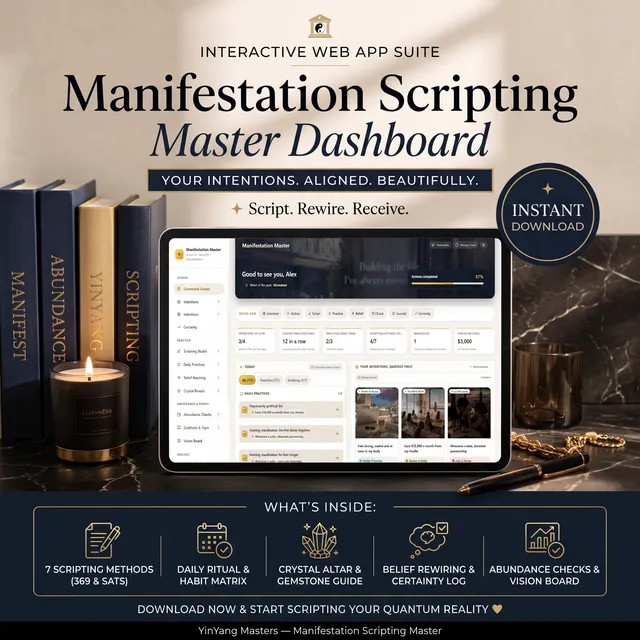
To systematize this process without relying on fragmented scraps of paper, the Manifestation Journal & Scripting Planner provides an offline web application interface designed specifically for intention tracking. It pairs each written script with obstacle identification and logs a weekly certainty score from 1 to 10, allowing you to observe whether your confidence stems from genuine action rather than fleeting moods.

Try it right here
Loading tool...

Neurological Mechanisms: Reticular Activating System vs Magical Thinking

When people claim that manifestation draws serendipity and luck out of thin air, they are usually describing an authentic neurological filter: the reticular activating system (RAS). Situated at the base of the brainstem, the RAS is a dense bundle of neurons that acts as a sensory gatekeeper, sifting through millions of sensory inputs per second and delivering only relevant data to conscious awareness.

If you spend your days consumed by unconscious narratives of scarcity or frustration, your RAS treats scarcity as your operational priority, highlighting obstacles and confirming your pessimistic expectations. Conversely, as explored in our breakdown of Lucky Girl Syndrome affirmations and RAS rewiring, deliberately writing clear intentions trains the RAS to flag relevant opportunities, professional openings, and resources that were previously disregarded as ambient background noise.

"The universe does not rearrange physical matter to grant your wishes; your reticular activating system simply stops filtering out the solutions that were already surrounding you."

The crucial difference between grounded neuroscience and magical thinking lies in agency. Magical thinking assumes that external coincidences occur independent of physical engagement. Neurological alignment recognizes that primed attention only yields outcomes when paired with behavioral habit formation. When you link your daily intentions to established behavioral triggers—a concept detailed in our guide on how to habit stack for behavioral consistency—you eliminate reliance on fluctuating emotional enthusiasm and construct an unbroken rhythm of execution.

The 5-Minute Container Protocol: Ending Obsessive Reality-Checking Loops

A destructive psychological trap common among manifestation practitioners is the obsessive reality-checking loop. After scripting a desire, an individual spends hours scanning their bank account, refreshing email inboxes, or monitoring personal interactions for tangible "signs." When instant breakthroughs fail to materialize, anxiety surges, triggering feelings of inadequacy or the self-blaming belief that their "vibration wasn't high enough."

To break this loop, practitioners often receive the simplistic advice to "just let go and forget your desire." However, cognitive psychology confirms that deliberate thought suppression invariably backfires, intensifying the forbidden thought through the ironic rebound effect. A healthier, evidence-based approach is the Action-Then-Release Routine anchored by a strict 5-Minute Container Protocol:

Step 1: Open the Container (Minutes 0 to 5)

Open your physical journal or planner at a fixed hour each morning. Complete your WOOP scripting: write your wish, feel the desired outcome for thirty seconds, honestly record the daily obstacle, and write out your if-then response.

Step 2: Execute One Immediate Micro-Action (Minutes 5 to 15)

Before closing your journal, complete one non-negotiable physical action related to your plan. Draft one pitch email, complete five minutes of focused research, or outline a project brief. Grounding the intention in immediate kinetic effort relieves cognitive tension.

Step 3: Close the Container and Re-enter Physical Reality

Physically snap the notebook shut or lock the application. Explicitly affirm to yourself: "My intentional work for today is complete. The container is closed." Devote the remainder of your waking hours to ordinary life, craft, and human connection without obsessing over timelines.

By boxing your manifestation practice into a disciplined daily container, you dismantle the chronic hypervigilance that breeds anxiety. Manifestation ceases to be a desperate plea for cosmic rescue and becomes what it was always meant to be: a calm, systematic architecture for living intentionally in the real world.

Sources & Verified References

Frequently Asked Questions

·

Positive thinking must be paired with mental contrasting and implementation intentions (the WOOP model). While visualizing your goal clarifies the direction, identifying the internal obstacles holding you back and formulating an 'If-Then' action plan provides the neurological fuel and behavioral structure required to achieve real results.

Pillar Topic

Explore Pillar Guide

Read Guide →
2027 Digital Planner — Goal Planner, Monthly Calendar & Zodiac Year Forecast

Tools and crystals for your practice

FREE INTERACTIVE GUIDE

Get Your Free 2027 Angel Number Year Map

Enter your birthday to reveal your 2027 Personal Year, the angel number guiding each month, and a private workspace to set your intentions.

100% privacy protected. No spam, unsubscribe anytime.

Ask Yinyang Masters inside your AI assistant

Get the same calculations and guidance right in your chat: add the free Yinyang Masters app, then ask in plain English. No account needed.

Try asking: “Find a Yinyang Masters guide about starting a daily spiritual practice.”

Moon Keeper, a white fox in a dark robe, meditating by candlelight
Live now

Meet Moon Keeper, our live altar host

Every hour Moon Keeper reads the sky, draws one tarot card and shares a calm 3-minute reflection. Drop by the altar, follow the hourly diary and leave a note in the guestbook.