To learn how to habit stack, anchor a new desired micro-behavior onto an established daily routine using the formula: "After [current habit], I will [new habit]." By attaching unfamiliar behaviors to automated neural circuits like brewing morning coffee, you eliminate cognitive friction, bypass willpower fatigue, and establish lasting behavioral chains.
How to Habit Stack: Step-by-Step Behavioral Guide and Routine Design

Jennie Uyên Chu
Chuyên gia Tâm thức & Năng lượng

Bài này hiện chỉ có bản tiếng Việt.
Ứng dụng thực hành tương tác · Bản trọn bộ13 phân hệ
Sổ Theo Dõi Thói Quen & Chuỗi Ngày
Bạn giữ chuỗi ngày được lâu hơn vì được nhắc ngay khi lỡ 2 ngày liền, và nhìn một cái là biết tỉ lệ hoàn thành của từng thói quen.
Web app dùng trên điện thoại hoặc laptop. Tích từng thói quen mỗi ngày, chuỗi ngày, chồng thói quen và thử thách tự cập nhật. Không cần nhập ngày sinh.
👥 38.000+ học viên👥 38.000+ học viên · Cộng đồng 2,4M+
27,99 US$20,99 US$27,99 US$729.000 ₫546.000 ₫729.000 ₫Bước 1 · Chọn điều khiến bạn dễ bỏ dở nhất khi tự làm:
Cách ứng dụng tháo gỡ đúng điểm nghẽn này
Ghép thói quen gắn mỗi thói quen mới vào việc bạn vốn đã làm, nó đi theo đà sẵn có thay vì dựa vào ý chí.
Công cụ có sẵn bên trong: Ghép thói quen gắn mỗi thói quen mới vào việc bạn vốn đã làm, có giờ cho từng bước, để việc mới nối liền vào thói quen hằng ngày.
Bước 2 · Xem trực tiếp giao diện thật bên trong
Thiết kế Chuỗi Ghép Thói quen
13 phân hệ · 2 tab mở thử miễn phíGhép thói quen mới ngay sau một việc bạn đã làm hằng ngày, kèm phiên bản tối giản 2 phút cho ngày bận.
Trả 1 lần duy nhất · Dùng trọn đời · Nhận qua email tức thì

Bản Đồ Số Thiên Thần 2027 miễn phí
Nhận qua email Bản Đồ Số Thiên Thần 2027 kèm bảng tự tra Năm Cá Nhân, con số thiên thần từng tháng và chỗ viết ý định cả năm.
Most personal development initiatives collapse not from an absence of ambition, but from an architectural defect in behavioral design. Attempting to build demanding new disciplines from scratch creates friction in the prefrontal cortex, forcing the conscious brain to expend precious metabolic energy on basic decisions. By mastering the principles outlined in the Atomic Habits habit stacking framework, you can harness pre-existing cognitive momentum to make progressive daily upgrades virtually effortless.
How to Habit Stack: The Core Behavioral Formula and Implementation Intentions
At its operational foundation, habit stacking is an advanced application of what behavioral psychologist Peter Gollwitzer termed implementation intentions. Classical self-improvement advice often instructs people to rely on abstract intentions, such as "I will exercise more often" or "I will read every day." Clinical research confirms that vague intentions rarely translate into somatic action because they lack an unambiguous environmental trigger.
When you specify the exact moment, physical location, and preceding cue for an action, your subconscious mind prepares the motor cortex in advance. James Clear adapted this principle into an elegant, scalable syntax that forms the bedrock of habit stacking:
The Golden Syntax of Habit Stacking
"After [CURRENT ESTABLISHED HABIT], I will [NEW MICRO-ACTION]."
The primary criterion for a successful stack is selecting an anchor habit that is non-negotiable and already executed with 100% daily reliability. Automated actions such as taking off your shoes when arriving home, pouring hot water into a mug, or closing your laptop at the end of the workday possess high synaptic stability. Hitchhiking a new habit onto these immovable anchors bypasses the need for emotional motivation. Similar to the principles of proactive mindset mastery discussed in our guide on the Bob Proctor goal card methodology, environmental clarity always outperforms sheer willpower.
Step-by-Step Guide: Designing Morning, Workday, and Evening Habit Chains
Constructing a resilient habit stack requires systematic progression through four sequential stages. Moving too quickly or stacking multiple high-friction habits simultaneously overloads cognitive bandwidth, triggering systemic drop-off within days. Follow this deliberate 4-step implementation protocol:
Công cụ tra cứu miễn phí
Tính Số Đường Đời Thần Số Học
Trả lời nhanh
Có. Sổ Theo Dõi Thói Quen & Chuỗi Ngày — Habit Tracker, Habit Stacking, Thử Thách 75 Ngày & Tái Tập Trung được làm cho đúng việc này: Thấy chuỗi ngày hiện tại, chuỗi dài nhất và tỉ lệ hoàn thành 7/30 ngày của từng thói quen.
 Sổ Theo Dõi Thói Quen & Chuỗi Ngày — Habit Tracker, Habit Stacking, Thử Thách 75 Ngày & Tái Tập TrungXem Sổ tay Tương tác →
- Audit Your Current Daily Anchors: Create a comprehensive list of fixed, involuntary physical events you complete each day from the moment your feet touch the floor. Categorize them by temporal window (morning awakening, work transition, dinner, pre-bedtime).
- Select an Ultra-Low Activation Habit: Choose one micro-habit that takes less than two minutes to perform. If your ultimate goal is reading 30 pages a day, scale the stacked habit down to opening your book to page one. Removing initial inertia is the single most critical variable in neural habit acquisition.
- Define Precise Environmental Placement: Specify where the physical items required for the habit reside. If your stack involves writing your daily priorities, place your dedicated journal directly atop your keyboard the evening before.
- Lock In a 14-Day Single-Stack Period: Commit to running exactly one new connection for two full weeks before adding a subsequent link. Stabilizing the first link ensures the neural bridge is mechanically sound before adding weight.

To visualize how high-leverage individuals structure their daily momentum, review the comprehensive behavioral matrix below. Incorporating dedicated tactile tools such as the Atomic Habits Habit Stacking Tracker allows you to visually log completion and build an unshakeable consistency streak.
| Daily Phase | Established Anchor Cue | Stacked Micro-Habit | Compound Behavioral Outcome |
|---|---|---|---|
| Morning Awakening | Turning off the bedside alarm clock | Drinking 16 ounces of mineral-rich water | Rapid cellular rehydration and metabolic activation |
| Deep Work Transition | Placing coffee mug onto the desk surface | Setting mobile devices to Airplane Mode | Elimination of cognitive switching costs and digital drift |
| Midday Physicality | Closing the laptop lid for lunch break | Performing 10 bodyweight squats or somatic stretching | Lymphatic circulation and postural tension release |
| Work Shutdown | Closing the primary email inbox tab | Recording top three priority targets for tomorrow | Mental closure preventing evening rumination (Zeigarnik effect) |
| Nocturnal Wind-Down | Connecting phone to charger outside bedroom | Reading two pages of contemplative literature | Melatonin synthesis and parasympathetic nervous activation |
The Cognitive Neuroscience of Habit Stacking: Synaptic Pruning and Basal Ganglia Encoding
To understand why habit stacking demonstrates such profound longevity compared to standard goal-setting methods, one must examine the neurological architecture of the mammalian brain. Every human action begins as an energy-intensive calculation in the prefrontal cortex—the region responsible for executive function, impulse inhibition, and conscious decision-making.
The brain represents merely 2% of total human body mass yet consumes over 20% of resting metabolic glucose. Because nature prioritizes energetic conservation for biological survival, the central nervous system seeks to automate any pattern of behavior that is repeated across identical temporal cues. Through a continuous neurodevelopmental process known as synaptic pruning, frequently traversed synaptic connections are reinforced with thick myelin sheaths, while neglected pathways are gradually degraded.
As an action becomes habitual, neurological control shifts from the volatile prefrontal cortex down into the basal ganglia—an ancient, primitive structure located deep near the brainstem. The basal ganglia processes motor memory and routine execution with minimal glucose expenditure. When you execute an anchor cue such as brushing your teeth or brewing morning coffee, your basal ganglia runs a deeply encoded "chunk" of automated motor code.
Habit stacking functions as a biological Trojan horse. Instead of demanding that your prefrontal cortex construct a brand-new, unmyelinated neural circuit through brute cognitive effort, habit stacking splices the new micro-behavior directly onto the terminus of an existing basal ganglia chunk. In behavioral terms, the established habit acts as a biological locomotive, pulling the new habit along its existing tracks. This physiological reality reinforces the philosophy examined in our review of Jocko Willink's discipline frameworks: true freedom originates from structured, automated self-mastery.
Habit Stacking vs. Temptation Bundling: Differences, Tradeoffs, and Strategic Combinations
While habit stacking focuses on structural sequence and environmental anchoring, another prominent behavioral architecture technique is temptation bundling, pioneered by behavioral economist Katy Milkman at the University of Pennsylvania. Understanding the tactical distinction between these two mechanisms enables you to deploy the proper framework for specific behavioral hurdles:
- Habit Stacking (Structural Sequencing): Pairs an established routine with a necessary new habit (e.g., "After I brew coffee, I will write down three priorities."). The psychological driver is environmental predictability and automated cues.
- Temptation Bundling (Dopaminergic Pairing): Pairs a high-discipline task with an immediate reward behavior (e.g., "I will only listen to my favorite true-crime audio show while walking on the treadmill."). The psychological driver is immediate anticipatory dopamine.
Rather than treating these methodologies as mutually exclusive, advanced habit designers engineer composite habit loops. In this combined structure, habit stacking provides the initiation trigger, while temptation bundling supplies the dopaminergic pull that sustains the session. For instance:
"After I sit down at my desk and open my task manager (Habit Stack), I will sip my favorite single-origin matcha tea while reviewing complex data (Temptation Bundle)."
Coupling these behavioral triggers with physical accountability instruments, like The 5 Second Rule Action Journal, provides the tactile feedback required to cement your compound routines across multi-month training phases.
Adapting Habit Stacking for ADHD: Overcoming Working Memory Lapses and Dopamine Dips
For neurodivergent individuals, particularly those navigating Attention-Deficit/Hyperactivity Disorder (ADHD), conventional habit advice frequently falls short. The neurotypical model of habit formation assumes a steady baseline of tonic dopamine and functional working memory. In the ADHD nervous system, dopamine transmission is characteristically dysregulated, and working memory buffers are prone to instantaneous disruption whenever external stimuli intervene.
When a person with ADHD attempts a standard five-step habit stack, an unexpected phone notification or a brief sensory distraction between step two and step three can completely dissolve the behavioral chain. To make habit stacking resilient against executive dysfunction, implement these three neurodivergent modifications:
1. Employ Multisensory Physical Anchors
Abstract mental triggers like "after I feel relaxed" do not exist for the ADHD brain. Anchors must be stark, tactile, and visible. Use bright physical items—such as placing a glass tumbler directly over your kitchen faucet—so the cue physically interrupts your physical path.
2. Enforce the Two-Step Chain Ceiling
Never attempt to build a linear stack exceeding two links (Anchor Cue + Micro Action) until the pair has operated flawlessly for 30 consecutive days. Long chains create catastrophic failure points where one missed link aborts the entire morning flow.
3. Create Immediate Somatic Closure
Because ADHD brains require acute dopamine feedback to validate completion, physically checking off a box on paper, ringing a small desk bell, or taking a deep sensory breath provides the immediate neurochemical reinforcement necessary to encode the basal ganglia loop.
By honoring your biological individuality and implementing intentional behavioral architecture, habit stacking transforms personal productivity from a grueling battle of willpower into a graceful, compounding rhythm of lifelong self-mastery.
Công cụ tra cứu miễn phí cùng chủ đề



Áp dụng ngay
Đưa bài viết này vào thực hành
Suốt hơn 8 năm qua, cộng đồng hơn 2,4 triệu người theo dõi và 38.000+ học viên đã chia sẻ kết quả thật khi duy trì những thực hành này trong tình yêu, tài chính và sự bình an.
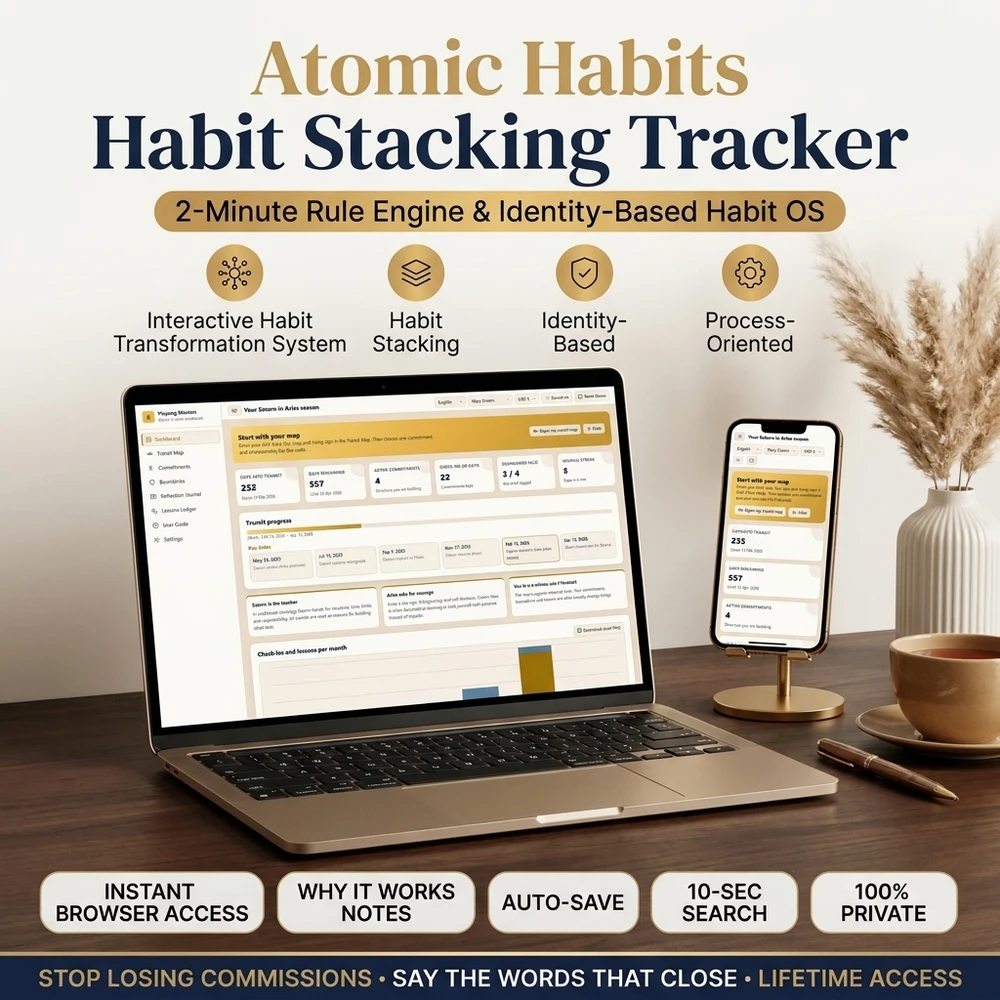
 Sổ Theo Dõi Thói Quen & Chuỗi Ngày — Habit Tracker, Habit Stacking, Thử Thách 75 Ngày & Tái Tập Trung
- Một web app thay cho các tờ theo dõi thói quen bằng giấy: chuỗi ngày, check-in, ghép thói quen và thử thách 75 ngày chung một chỗ, mở trên điện thoại hay laptop.
- Thấy chuỗi ngày hiện tại, chuỗi dài nhất và tỉ lệ hoàn thành 7/30 ngày của từng thói quen.
- Nhận cảnh báo khi bỏ lỡ 2 ngày liền để kịp quay lại trước khi bỏ hẳn.
 Mật Thư Trước Giấc Ngủ — 108 Lời Thanh Tẩy Ho'oponopono & Kịch Bản Nhập Cảnh SATS Khơi Thông Tài Lộc – Hàn Gắn Nhân Duyên
- Chọn nỗi bận tâm tối nay (tiền bạc, gia đình, tình cảm, công việc, giấc ngủ hay buông bỏ), sách mở đúng lời nguyện Ho'oponopono và một cảnh ngủ ngắn đi kèm.
- Đọc 108 lời nguyện viết cho tình huống thật, từ lúc nhìn số dư thấy nặng lòng tới tin nhắn mãi không được trả lời, câu chữ đơn giản để thì thầm.

Có trong cửa hàng
Sổ Theo Dõi Thói Quen (Chuỗi Ngày, Ghép Thói Quen & Thử Thách)
Cuối cùng cũng giữ được những thói quen mình bắt đầu. Thấy rõ thói quen nào đang giữ, thói quen nào đang trượt, có lời nhắc nhẹ vào sáng hôm sau ngày lỡ, và gắn thói quen mới vào việc bạn vốn đã làm mỗi ngày.
Nguồn tham khảo & Đối chiếu
- [1]Lally et al. (2010), How Are Habits Formed: Modelling Habit Formation in the Real World (European Journal of Social Psychology) ↗
- [2]Gollwitzer (1999), Implementation Intentions: Strong Effects of Simple Plans (American Psychologist) ↗
Được biên tập theo chuẩn thực hành chánh niệm & phát triển cá nhân. Chính sách biên tập
Chủ Đề Trụ Cột
Kỹ Thuật Chồng Thói Quen (Habit Stacking) & Quy Tắc 2 Phút Trong Atomic Habits
Bộ Sổ Tay & Hệ Thống Tương Tác Đi Kèm


Câu chuyện thật
Xem mọi câu chuyện →Người đọc đã thay đổi thế nào với những thực hành này
Đây cũng là thói quen thực hành mà cộng đồng hơn 2,4 triệu người theo dõi đã dùng suốt 8 năm, với 38.000+ học viên chia sẻ kết quả của mình.
 Chuyện tình yêu
Nhật ký Twin Flame có hiệu quả không? Câu chuyện thật
Nhật ký twin flame có hiệu quả không? Câu chuyện thật về chữa lành sau chia tay, thu hút tri kỷ, tìm lại bình yên và cách luyện tập mỗi ngày.
Xem cẩm nang Chuyện tiền bạc
Nhật ký thu hút tiền bạc có hiệu quả không? Chuyện thật
Nhật ký thu hút tiền bạc có hiệu quả không? Câu chuyện thật về trả hết nợ, xin tăng lương, bớt lo âu tiền bạc và cách luyện tập mỗi ngày.
Xem cẩm nang
 Chuyện tình yêu
Thu hút tình yêu sau chia tay: chuyện chữa lành có thật
Câu chuyện thật về thu hút tình yêu sau chia tay: dùng câu khẳng định yêu bản thân, soi gương và nhật ký tình yêu để chữa lành trước rồi mở lòng lại.
Xem cẩm nang Chuyện tiền bạc
Thu hút cuộc sống sạch nợ: câu chuyện thật
Câu chuyện thật về thu hút cuộc sống sạch nợ: kết hợp câu khẳng định tiền bạc, nhật ký thịnh vượng với mục tiêu rõ, hạn chót và bằng chứng mỗi ngày.
Xem cẩm nang Chuyện tình yêu
Thu hút tri kỷ: câu chuyện thật bắt đầu từ bên trong
Câu chuyện thật về thu hút tri kỷ: viết kịch bản người bạn đời lý tưởng, làm bảng tầm nhìn và mở lòng với cuộc sống trước khi tình yêu đến.
Xem cẩm nang Chuyện tiền bạc
Thu hút tăng lương: câu chuyện thật về sự tự tin
Câu chuyện thật về thu hút tăng lương, thăng chức: gỡ niềm tin cản trở, luyện câu khẳng định tự tin và ghi bằng chứng trước khi đề nghị.
Xem cẩm nang Chuyện tình yêu
Câu chuyện đoàn tụ twin flame: hành trình thật về bình yên
Câu chuyện đoàn tụ twin flame có thật: dùng các giai đoạn hành trình, sổ dấu hiệu và thiền dẫn để tìm bình yên khi xa cách, dù có quay lại hay không.
Xem cẩm nang Chuyện tiền bạc
Từ lo âu tiền bạc đến bình tâm: câu chuyện thật
Câu chuyện thật về vượt qua lo âu tiền bạc: một bài thiền ngắn trước khi xem tài khoản, buổi hẹn hò với tiền mỗi tuần và soi lại niềm tin cũ.
Xem cẩm nang
Hướng dẫn liên quan


Bài viết khác



Đang được đọc nhiều
Bài mọi người mở nhiều nhất tuần này
Xếp theo lượt xem thật trong 7 ngày qua.




🔥 Bắt đầu Ngày 1 ngay tối nay · Mua 1 lần dùng mãi
Sổ Theo Dõi Thói Quen & Chuỗi Ngày — Habit Tracker, Habit Stacking, Thử Thách 75 Ngày & Tái Tập Trung
Ứng dụng web theo dõi thói quen: điểm danh mỗi ngày, chuỗi ngày, chuỗi thói quen, thử thách và nhật ký cơn thèm, để bạn thấy thói quen nào đang giữ được, thói quen nào đang trượt.
TÀI LIỆU TƯƠNG TÁC MIỄN PHÍ
Nhận Miễn Phí Bản Đồ Số Thiên Thần Năm 2027
Nhận qua email Bản Đồ Số Thiên Thần 2027 kèm bảng tự tra Năm Cá Nhân, con số dẫn đường từng tháng và góc riêng viết ý định cả năm.
Theo dõi Yin Yang Masters
Nghi thức mỗi ngày ngay trên bảng tin của bạn
Hướng dẫn ngắn, nghi thức theo trăng và cách dùng sổ kế hoạch từ Yin Yang Masters.




Khám phá thêm
Thêm từ Yin Yang Masters



Hỏi Yinyang Masters ngay trong trợ lý AI của bạn
Nhận cùng phép tính và gợi ý ngay trong khung chat: thêm app Yinyang Masters miễn phí rồi hỏi bằng lời thường. Không cần tài khoản.
Thử hỏi: “Tìm bài hướng dẫn Yinyang Masters về bắt đầu thực hành tâm linh mỗi ngày.”

Đang trực
Gặp Moon Keeper, người giữ điện thờ trực tiếp
Mỗi giờ Moon Keeper đọc bầu trời, rút một lá tarot và chia sẻ một bài tĩnh tâm 3 phút. Ghé điện thờ, theo dõi nhật ký từng giờ và để lại lời nhắn trong sổ khách.

BẢN TIN MIỄN PHÍ MỖI NGÀY
Nhận Bản Tin Yin Yang Masters Mỗi Ngày
Mỗi ngày một email ngắn: một thực hành cho hôm nay, một câu chuyện thật của bạn đọc và bài hướng dẫn mới nhất về tình yêu, tiền bạc, sự bình an.
Suốt hơn 8 năm qua, cộng đồng hơn 2,4 triệu người theo dõi và 38.000+ học viên đã chia sẻ kết quả thật khi duy trì những thực hành này trong tình yêu, tài chính và sự bình an.