

Ho'oponopono for Sleep: A 4-Phrase Bedtime Routine


Bài này hiện chỉ có bản tiếng Việt.
Sổ Shadow Work & Chữa Lành Bằng Âm Thanh
Bạn hiểu điều gì thật sự khiến mình bị kích hoạt và biết cách nào giúp mình dịu lại nhanh nhất, nhìn rõ qua biểu đồ mỗi tuần.
Web app dùng trên điện thoại hoặc laptop. Ghi cơn kích hoạt, trả lời câu hỏi shadow work và nghe bộ âm thanh. Không cần nhập ngày sinh.
Bước 1 · Chọn điều khiến bạn dễ bỏ dở nhất khi tự làm:
Cách ứng dụng tháo gỡ đúng điểm nghẽn này
Nhật ký kích hoạt ghi điều gì làm bạn bùng lên và điều gì làm dịu, nên khuôn mẫu cũ dần buông bạn ra.
Công cụ có sẵn bên trong: Mỗi chủ đề gom mọi ghi chép về những phản ứng và nỗi sợ cứ lặp lại, để bạn thấy được khuôn mẫu thay vì những ngày tồi tệ rời rạc.
Bước 2 · Xem trực tiếp giao diện thật bên trong
Giao diện điều phối theo dõi chủ đề shadow đang làm việc, nhịp cảm xúc và danh sách module hướng dẫn.
Trả 1 lần duy nhất · Dùng trọn đời · Nhận qua email tức thì

Bản Đồ Số Thiên Thần 2027 miễn phí
Nhận qua email Bản Đồ Số Thiên Thần 2027 kèm bảng tự tra Năm Cá Nhân, con số thiên thần từng tháng và chỗ viết ý định cả năm.
Ho'oponopono for sleep is a 10-minute bedtime routine that repeats four short phrases (I love you, I'm sorry, please forgive me, thank you) for 12 slow rounds, so the last thing your mind rehearses is release instead of replay. It pairs a Hawaiian reconciliation practice with a 4-minute pace and a 30-second breathing reset. It is a calming ritual, not a sleep treatment. For the full background, read the Ho'oponopono cleansing and forgiveness guide.
Most people reach for Ho'oponopono at night because the mind gets loudest in bed: an awkward conversation, an unpaid bill, a message left on read. The four phrases give that loop a script with an ending. Below you get the exact routine, a pacing table, a 7-night log you can copy into any notebook, and the limits of what a bedtime practice can do.
Ho'oponopono for Sleep: The 4-Phrase Bedtime Routine
The routine takes 10 minutes from lights-dim to lights-out. Twelve rounds of the four phrases at a slow pace last about 4 minutes; the rest of the time goes to setup and a quiet close. Keep the sequence identical every night, because a repeated cue is what turns a practice into a bedtime signal.
- Minutes 0 to 2, set the room. Dim the lights, put your phone out of arm's reach, and sit or lie down in your usual sleep position.
- Minute 2, name one thing. Pick the single memory, person, or worry that is loudest right now. Name it in one short sentence, such as "the argument at lunch." Only one item per night.
- Minutes 2 to 6, say the four phrases. Say each phrase silently on a slow exhale: "I love you. I'm sorry. Please forgive me. Thank you." That is one round. Complete 12 rounds, about 20 seconds each.
- Minutes 6 to 8, stay with the sensation. Stop the words. Notice where the memory sits in your body, whether chest, jaw, or stomach, and let your attention rest there without trying to change it.
- Minutes 8 to 10, close the container. Say "that is enough for tonight," turn over, and let the practice end. You do not need to feel different for it to count.
The phrases are aimed at your own replay loops, not at the other person. In this practice you are not confessing to something you did not do; you are acknowledging the memory that keeps playing and offering it a way to wind down.
Công cụ tra cứu miễn phí
Tính Số Đường Đời Thần Số Học
Trả lời nhanh
Có. Sổ Shadow Work 30 Ngày bản khởi đầu — Nhật ký kích hoạt, bản đồ bóng tối và câu gợi ý viết được làm cho đúng việc này: Ghi điều khiến bạn bị kích hoạt kèm mức 0–10 trước và sau, và xem công cụ nào giúp bạn dịu nhất.
 Sổ Shadow Work 30 Ngày bản khởi đầu — Nhật ký kích hoạt, bản đồ bóng tối và câu gợi ý viếtXem Sổ tay Tương tác →
Ho'oponopono Prayer for Sleep: Pacing, Breath, and a 7-Night Log
Fast repetition keeps the mind busy, and a busy mind is the opposite of what you want at 11 p.m. Pace the words to your exhale, and use a short breathing reset first if your body feels wired.
The 30-Second Somatic Reset (do this before round one)
Take two quick sips of air through the nose, then one long, slow exhale through the mouth. Repeat for 30 seconds, then let your eyes rest on three fixed points in the room, such as the door frame, the lamp, and the window edge. A randomized controlled study in Cell Reports Medicine found that 5 minutes a day of exhale-focused "cyclic sighing" for one month improved mood and lowered breathing rate more than the same time spent in mindfulness meditation. The study measured mood and arousal, not sleep, so treat the reset as a way to lower the volume before the words begin.
Pacing table
| Moment | Pace | What you are doing |
|---|---|---|
| Rounds 1 to 4 | About 6 seconds per phrase | Matching each phrase to one full exhale |
| Rounds 5 to 8 | About 5 seconds per phrase | Letting the rhythm settle without speeding up |
| Rounds 9 to 12 | About 4 seconds per phrase | Dropping the effort; words get quieter |
| After round 12 | No words | Resting attention on the body sensation |

The 7-night bedtime log
One line per night is enough. Rate how busy your mind feels on a 1 to 5 scale before and after, where 5 is "racing." After 7 nights you have a personal baseline instead of a guess.
| Night | Item you named | Rounds done | Mind-busy before (1-5) | Mind-busy after (1-5) | Note |
|---|---|---|---|---|---|
| 1 | 12 | ||||
| 2 | 12 | ||||
| 3 | 12 | ||||
| 4 | 12 | ||||
| 5 | 12 | ||||
| 6 | 12 | ||||
| 7 | 12 |
If your "after" score does not drop by at least 1 point on 4 of the 7 nights, change one variable only: shorten to 6 rounds, move the practice 30 minutes earlier, or swap the spoken words for a silent count. Changing one thing at a time tells you which adjustment worked.
Action, then release
If the item you named needs a real step, such as an email or a payment, write that one step on paper before the rounds, then put the paper face down. The practice is for the replay, the paper is for the task. Closing the loop on paper keeps you from checking the result in bed.
What Ho'oponopono Meditation Is (and Where the Four Phrases Come From)
Ho'oponopono is a Hawaiian practice whose name translates to "to make right." In its traditional form it was a family gathering where relatives talked through a broken relationship until it was repaired, sometimes daily or weekly. As described on the Ho'oponopono entry, a healing practitioner named Morrnah Simeona adapted it in 1976 into a private, self-directed method, and the four-phrase version became widely known through psychologist Ihaleakala Hew Len and the 2007 book Zero Limits.
That history matters for one practical reason: the phrase order is not fixed. Some teachers begin with "I love you," others with "I'm sorry." Pick one order and keep it for all 7 nights, because consistency matters more than the particular sequence.
Treat the practice as a reflective ritual. The claim that it changes outside events is a belief, not a measured result, and this routine does not depend on it. What the routine does offer is a repeatable 10-minute structure for ending the day with forgiveness language instead of rumination.
Ho'oponopono for Insomnia and Deep Sleep: What to Expect and When to Get Help
A bedtime ritual can make winding down easier, and it can sit alongside ordinary sleep hygiene: a regular bedtime, a dim room, and no screens in the last 30 minutes. It is not a treatment for insomnia. Chronic insomnia is generally defined as trouble sleeping at least 3 nights a week for at least 3 months, and that pattern deserves a conversation with a doctor or sleep specialist, not another ritual.
| What you notice | Reasonable response |
|---|---|
| Mind slows within 10 to 20 minutes | Keep the routine as written |
| Phrases feel forced or irritating | Drop to 6 rounds or use silent breathing only |
| Strong emotion rises (tears, tight chest) | Stop the words, breathe, and write one line in your log |
| Poor sleep 3 nights a week for 3 months | Book an appointment with a clinician |
If a particular memory is heavy enough that it returns every night, such as grief or a painful relationship, a licensed counselor is a better partner for it than a bedtime phrase. The routine is a gentle support, and it works best on ordinary daily friction.
Ho'oponopono Music and Sleep Talk-Downs: Audio Without the Overstimulation
Many people ask about playing Ho'oponopono music or a guided talk-down. Audio can help you keep a steady pace, with two limits. Choose tracks with no sudden volume changes, and set a sleep timer for 20 to 30 minutes so the recording ends before you do. Playing the phrases all night is not part of this routine; the practice is the 10 minutes you take part in, not a loop running in the background.
Your own voice, even in a whisper, is the stronger anchor because it ties the words to your exhale. Use a recording only to learn the rhythm, then switch to silent practice by night 4. If you want a gentler way to approach the forgiveness side of the practice during the day, the forgiveness workbook post covers journaling prompts, and the inner child meditation script pairs well with an evening wind-down. For more on how daily practices shape your state, see what is my vibrational frequency.
Công cụ tra cứu miễn phí cùng chủ đề

Áp dụng ngay
Đưa bài viết này vào thực hành
Suốt hơn 8 năm qua, cộng đồng hơn 2,4 triệu người theo dõi và 38.000+ học viên đã chia sẻ kết quả thật khi duy trì những thực hành này trong tình yêu, tài chính và sự bình an.
 Sổ Shadow Work 30 Ngày bản khởi đầu — Nhật ký kích hoạt, bản đồ bóng tối và câu gợi ý viết
- Ghi điều khiến bạn bị kích hoạt kèm mức 0–10 trước và sau, và xem công cụ nào giúp bạn dịu nhất.
- Đặt tên cho những phần trong bạn hay phản ứng, câu chuyện cũ mỗi phần kể và điều nó cần, rồi xem mỗi phần xuất hiện bao nhiêu lần.
 Sổ Shadow Work & Chữa Lành Bằng Âm Thanh — Nhật Ký Cơn Kích Hoạt & Tần Số Solfeggio
- Ghi từng cơn kích hoạt kèm cảm giác trên cơ thể, mức độ trước và sau (0–10) và công cụ bạn đã dùng.
- Xem biểu đồ hằng tuần và bảng xếp hạng công cụ cho biết điều gì thật sự giúp bạn dịu lại.

Sổ Bài Tập Đứa Trẻ Bên Trong
Nhẹ nhàng nuôi dưỡng lại đứa trẻ ngày xưa của bạn. Trả lời 90 câu hỏi chữa lành, viết thư cho bé, đáp ứng nhu cầu thời thơ ấu và thực hành tha thứ cùng bài thiền dẫn.
Nguồn tham khảo & Đối chiếu
- [1]Ho'oponopono — Wikipedia ↗
- [2]Sleep hygiene — Wikipedia ↗
- [3]Insomnia — Wikipedia ↗
- [4]Brief structured respiration practices enhance mood and reduce physiological arousal (Cell Reports Medicine, 2023) ↗
Được biên tập theo chuẩn thực hành chánh niệm & phát triển cá nhân. Chính sách biên tập
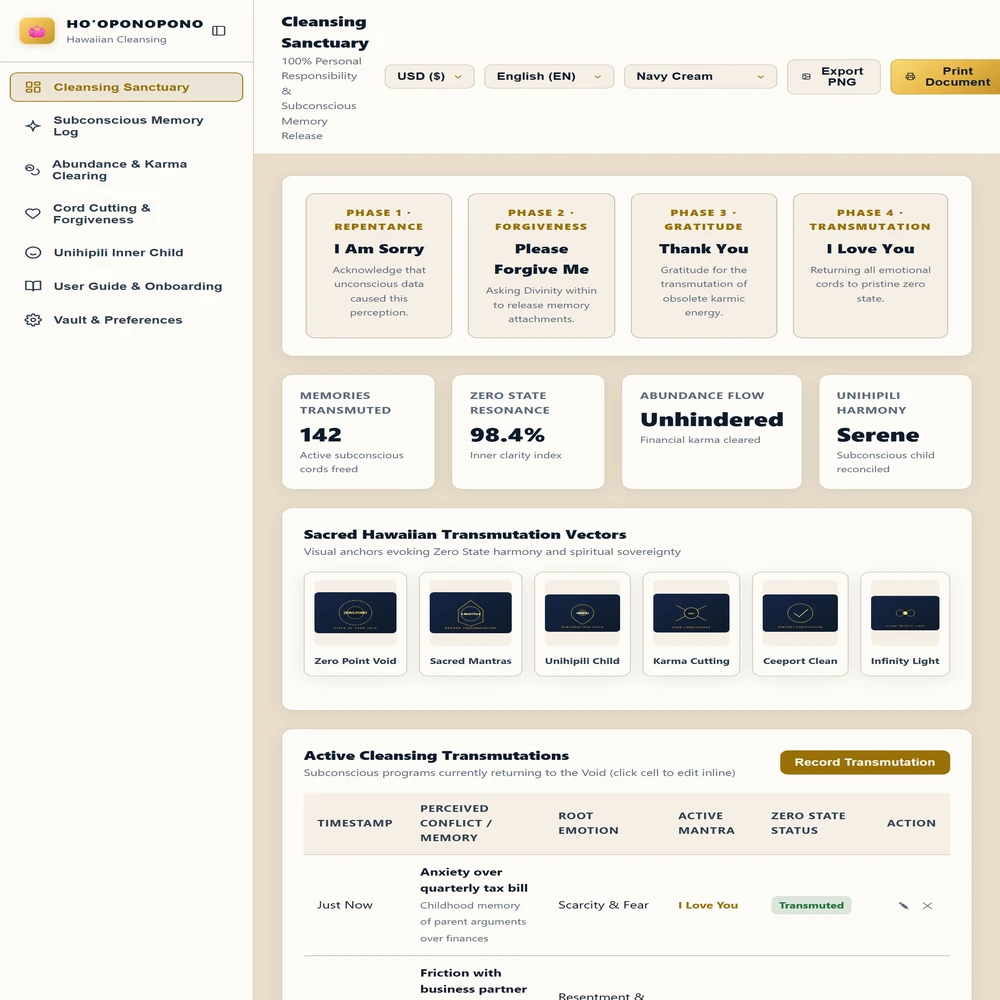
Bộ Sổ Tay & Hệ Thống Tương Tác Đi Kèm


Người đọc đã thay đổi thế nào với những thực hành này
Đây cũng là thói quen thực hành mà cộng đồng hơn 2,4 triệu người theo dõi đã dùng suốt 8 năm, với 38.000+ học viên chia sẻ kết quả của mình.
 Chuyện tình yêu
Nhật ký Twin Flame có hiệu quả không? Câu chuyện thật
Nhật ký twin flame có hiệu quả không? Câu chuyện thật về chữa lành sau chia tay, thu hút tri kỷ, tìm lại bình yên và cách luyện tập mỗi ngày.
Xem cẩm nang Chuyện tiền bạc
Nhật ký thu hút tiền bạc có hiệu quả không? Chuyện thật
Nhật ký thu hút tiền bạc có hiệu quả không? Câu chuyện thật về trả hết nợ, xin tăng lương, bớt lo âu tiền bạc và cách luyện tập mỗi ngày.
Xem cẩm nang
 Chuyện tình yêu
Thu hút tình yêu sau chia tay: chuyện chữa lành có thật
Câu chuyện thật về thu hút tình yêu sau chia tay: dùng câu khẳng định yêu bản thân, soi gương và nhật ký tình yêu để chữa lành trước rồi mở lòng lại.
Xem cẩm nang Chuyện tiền bạc
Thu hút cuộc sống sạch nợ: câu chuyện thật
Câu chuyện thật về thu hút cuộc sống sạch nợ: kết hợp câu khẳng định tiền bạc, nhật ký thịnh vượng với mục tiêu rõ, hạn chót và bằng chứng mỗi ngày.
Xem cẩm nang Chuyện tình yêu
Thu hút tri kỷ: câu chuyện thật bắt đầu từ bên trong
Câu chuyện thật về thu hút tri kỷ: viết kịch bản người bạn đời lý tưởng, làm bảng tầm nhìn và mở lòng với cuộc sống trước khi tình yêu đến.
Xem cẩm nang Chuyện tiền bạc
Thu hút tăng lương: câu chuyện thật về sự tự tin
Câu chuyện thật về thu hút tăng lương, thăng chức: gỡ niềm tin cản trở, luyện câu khẳng định tự tin và ghi bằng chứng trước khi đề nghị.
Xem cẩm nang Chuyện tình yêu
Câu chuyện đoàn tụ twin flame: hành trình thật về bình yên
Câu chuyện đoàn tụ twin flame có thật: dùng các giai đoạn hành trình, sổ dấu hiệu và thiền dẫn để tìm bình yên khi xa cách, dù có quay lại hay không.
Xem cẩm nang Chuyện tiền bạc
Từ lo âu tiền bạc đến bình tâm: câu chuyện thật
Câu chuyện thật về vượt qua lo âu tiền bạc: một bài thiền ngắn trước khi xem tài khoản, buổi hẹn hò với tiền mỗi tuần và soi lại niềm tin cũ.
Xem cẩm nang
Hướng dẫn liên quan

Bài viết khác


Đang được đọc nhiều
Bài mọi người mở nhiều nhất tuần này
Xếp theo lượt xem thật trong 7 ngày qua.





Sổ Shadow Work 30 Ngày bản khởi đầu — Nhật ký kích hoạt, bản đồ bóng tối và câu gợi ý viết
Sổ shadow work bản khởi đầu cho 30 ngày đầu tiên: ghi điều khiến bạn bị kích hoạt, vẽ bản đồ những phần trong bạn hay phản ứng, và viết qua 12 câu gợi ý.
Nhận Miễn Phí Bản Đồ Số Thiên Thần Năm 2027
Nhận qua email Bản Đồ Số Thiên Thần 2027 kèm bảng tự tra Năm Cá Nhân, con số dẫn đường từng tháng và góc riêng viết ý định cả năm.
Theo dõi Yin Yang Masters
Nghi thức mỗi ngày ngay trên bảng tin của bạn
Hướng dẫn ngắn, nghi thức theo trăng và cách dùng sổ kế hoạch từ Yin Yang Masters.



Khám phá thêm
Thêm từ Yin Yang Masters

Hỏi Yinyang Masters ngay trong trợ lý AI của bạn
Nhận cùng phép tính và gợi ý ngay trong khung chat: thêm app Yinyang Masters miễn phí rồi hỏi bằng lời thường. Không cần tài khoản.
Thử hỏi: “Tìm bài hướng dẫn Yinyang Masters về bắt đầu thực hành tâm linh mỗi ngày.”

Gặp Moon Keeper, người giữ điện thờ trực tiếp
Mỗi giờ Moon Keeper đọc bầu trời, rút một lá tarot và chia sẻ một bài tĩnh tâm 3 phút. Ghé điện thờ, theo dõi nhật ký từng giờ và để lại lời nhắn trong sổ khách.

Nhận Bản Tin Yin Yang Masters Mỗi Ngày
Mỗi ngày một email ngắn: một thực hành cho hôm nay, một câu chuyện thật của bạn đọc và bài hướng dẫn mới nhất về tình yêu, tiền bạc, sự bình an.
Suốt hơn 8 năm qua, cộng đồng hơn 2,4 triệu người theo dõi và 38.000+ học viên đã chia sẻ kết quả thật khi duy trì những thực hành này trong tình yêu, tài chính và sự bình an.