

John Bradshaw inner child work centers on reconnecting your adult self with the repressed childhood self shaped by shame and unmet developmental needs. Popularized through his 1990 book Homecoming and PBS workshop series, this approach helps adults reclaim curiosity while building steady internal safety in 10 minutes daily.
John Bradshaw Inner Child Work: Homecoming Stages, Exercises & Daily Reparenting

Jennie Uyen Chu
意识与能量专家

本文目前仅有越南语版本,中文版正在翻译中。
互动实践数字系统 · 完整版15 个模块
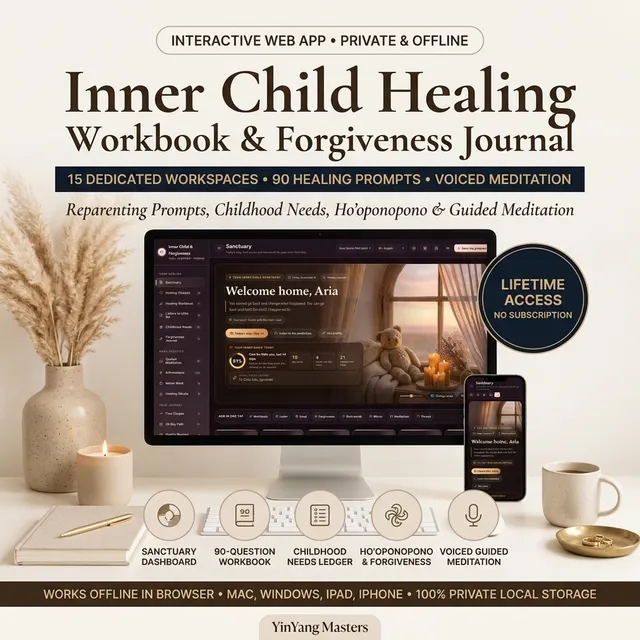
内在小孩疗愈练习册与宽恕日志
你会学着用温柔回应内心的批评声,感到更被照顾,这一点在 14 天关怀环上清楚可见。
网页应用,手机或电脑都能用。回答内在小孩问题,给小时候的自己写信,练习宽恕并播放引导冥想。无需填写出生日期。
👥 3.8万+学员👥 38,000+ 学员 · 240万+ 社群
US$39US$29.25US$39₫1,019,000₫764,000₫1,019,000第 1 步 · 点击你平时最容易半途而废的痛点:
这套应用如何帮你彻底解决
九十道温和的问题和 108 句肯定语,帮你一天一天用温柔回应那个旧声音。
内含对应工具: 108 句自我再养育肯定语分为六组,附重复计数和收藏功能,让温柔的话语慢慢成为每天的习惯。
第 2 步 · 直观查看应用真实模块界面
安全感中枢总览
15 个模块 · 2 个免费试用标签页柔和清晰的首页看板,追踪情绪安全感评分、安抚练习与各疗愈模块进度。
一次买断 · 终身可用 · 付款后即刻发送至邮箱

免费领取 2027 天使数字年度地图
通过邮件领取《2027 天使数字年度地图》,内附 2027 个人年速查、每个月的天使数字与全年意图书写空间。
Understanding theory feels comforting for a weekend, yet nervous-system patterns shift only when warm insights become small, repeatable actions. Before trying the four structured exercises below, explore our inner child healing and forgiveness workbook guide to see how consistent daily prompts helped adults quiet reactive self-criticism over four to eight weeks.
Reflection Disclaimer: John Bradshaw's self-reparenting and expressive journaling exercises support personal self-awareness and emotional reflection. They are not therapy or medical care and do not replace licensed mental-health treatment.
John Bradshaw Inner Child Work: The WONDER Child vs Wounded Adaptation
In John Bradshaw's model, every adult carries both a natural WONDER child and an adaptive wounded child formed during early stress. Separating authentic curiosity from shame-driven survival rules within 5 minutes of reflection helps interrupt automatic emotional spirals before they dictate adult relationships.
Many readers first discover the inner child concept through clips of Bradshaw's televised workshops or Oprah Winfrey interviews, where he challenged the idea that emotional maturity means burying vulnerability. Rather than viewing childhood triggers as personal weakness, his model distinguishes two contrasting internal states:
- The WONDER Child (Natural Vitality): Bradshaw's acronym stands for Wonder, Optimism, Naivete (innocence), Dependence (healthy trust), Emotions, and Resilience. This part drives playful creativity, spontaneous laughter, honest grief, and open-hearted curiosity when no threat is present.
- The Wounded Child (Shame-Based Adaptation): When caregivers are chronically distracted, harsh, or unpredictable, a child learns what Bradshaw called toxic shame—the belief that "I am a mistake" rather than "I made a mistake." Over decades, that unexamined fear masks itself as perfectionism, people-pleasing, emotional numbness, or sudden defensiveness.
- The Adult Protector (Conscious Champion): Unlike biological parents who may have lacked time or self-awareness, your present-day adult self possesses full agency, clean boundaries, and calm discernment to validate feelings without obeying panic.
Notice how closely shame-driven masks overlap with repressed emotions discussed in Carl Jung's shadow work and inner child healing guide. When toxic shame pushes natural anger or neediness underground, daily reflection brings those disowned reactions back into steady adult care.
免费在线测算工具
生命灵数计算器
快速解答
有。内在小孩疗愈练习册与宽恕日志 — 互动式自我再养育网页应用正是为此设计:按自己的节奏,回答觉察、拥抱、再养育、宽恕四个阶段的 90 道温和问题。
 内在小孩疗愈练习册与宽恕日志 — 互动式自我再养育网页应用查看交互式手册 →
The Four Developmental Stages in John Bradshaw's Homecoming Framework
Bradshaw organized childhood emotional development into four distinct stages—infancy, toddlerhood, preschool, and school-age—spanning ages 0 through 12. Pinpointing which specific developmental task stalled in 15 minutes of structured review reveals why present-day triggers flare around trust, autonomy, guilt, or comparison.
Drawing on developmental psychology, Homecoming maps each childhood window to a core emotional anchor and a recognizable adult pattern when that stage goes unmet:
- Stage 1 — Infant Trust (Ages 0 to 1): Healthy caregiving builds basic nervous-system safety through reliable responsiveness to hunger, warmth, and distress. When early attunement was inconsistent, adults often experience chronic hypervigilance, fear of intimacy, or difficulty resting without expecting sudden abandonment.
- Stage 2 — Toddler Autonomy (Ages 1 to 3): Testing "no," exploring physical space, and recovering from small spills builds clean personal agency. When curiosity met shaming anger or rigid control, adults tend to swing between rebellious stubbornness and compulsive compliance.
- Stage 3 — Preschool Initiative (Ages 3 to 6): Imaginative play, asking endless questions, and feeling welcomed in family life shapes healthy emotional expression. If a young child felt invisible or blamed for parental tension, adult life often brings silent guilt whenever choosing personal joy.
- Stage 4 — School-Age Industry & Identity (Ages 6 to 12): Learning rules, social belonging, and real-world competence fosters steady self-esteem. Harsh comparison or conditional affection during these years frequently produces an unforgiving inner critic, imposter patterns, and workaholic exhaustion.
Instead of trying to fix every memory at once, focus on one recurring adult friction point per week and trace which of the four stages it echoes. You can pair that weekly audit with targeted inner child healing journal prompts to keep insights grounded in concrete present-day choices.
Homecoming Book vs Loose PDFs vs Guided Inner Child Workbooks
Readers researching Bradshaw's work often debate between reading his 304-page Homecoming paperback, downloading loose free PDFs, or using a structured interactive workbook. Matching your current routine to the right medium prevents common drop-off after day 3 of solo reflection.
Conceptual books build essential language for recognizing family dynamics, yet reading alone rarely tracks how your needs or emotional reactivity shift over a 30-day cycle. Comparing four widely used formats clarifies which tool solves which practical bottleneck:
| Format | Core Mechanism | Best Fit For | Time Per Session | Key Practical Limitation |
|---|---|---|---|---|
| Homecoming Book & Lecture Series | Developmental theory, clinical case narratives, and guided reading meditations | First-time conceptual understanding and reducing personal shame | 25–40 minutes reading | Passive format; lacks interactive logs for daily needs or longitudinal mood tracking |
| Loose Printable PDF Worksheets | Single-session fill-in checklists and static non-dominant hand prompt sheets | One-weekend awareness check or print-and-discard reflection | 15–30 minutes once | Pages scatter easily; offers zero continuity between triggers, letters, and boundaries |
| Interactive Inner Child Workbook Web App | 4-stage structured questions, childhood photo letter cards, 8-need ledger, and voiced audio | Adults building a steady 10-minute private reparenting rhythm | 10–15 minutes daily | Requires quiet personal honesty and consistent daily check-ins for 14–30 days |
| Standalone Meditation Scripts | Guided visualization meeting younger developmental ages in calm imagery | Evening nervous-system settling and emotional warmth | 10–15 minutes listening | Can feel ungrounded unless paired with clear adult action and protective limits |
If you prefer a private digital sanctuary over loose paper printouts, compare calm offline options in our guide to a dedicated shadow work journal app. Keep every practice centered on small, verifiable habits that respect your energy and current support network.
4 Core John Bradshaw Inner Child Exercises and Daily Meditation Script
Bradshaw's core recovery practices center on non-dominant hand letter writing, developmental age validation, grief release, and guided adult sanctuary imagery. Spending 10 to 12 focused minutes each evening lets your grounded adult voice guide the conversation without slipping into overwhelm.

To hold every thread together in one private space, the Inner Child Healing Workbook & Forgiveness Journal connects a 14-day Sanctuary care ring with 90 questions across four stages—Recognize, Embrace, Reparent, and Forgive. Inside the same workspace, Letters to Little Me lets you pair a childhood photo with structured prompts, a childhood needs log tracks eight core needs, the forgiveness journal counts the four Ho'oponopono phrases alongside a clear boundary line, and the 12-minute voiced guided meditation Coming Home to Little You helps settle busy nights gently.
Whenever sharp present-day interpersonal triggers keep setting off defensive anger or perfectionist armor alongside childhood vulnerability, the Shadow Work & Sound Healing Journal helps log each trigger, rate somatic intensity before and after from 0 to 10, explore twelve guiding questions, and unwind with two original instrumental tracks tuned in 432 Hz and 528 Hz.
Before You Begin: The 30-Second Somatic Reset
Never begin deep memory work while your chest feels tight or your inner critic sounds loud and urgent. Spend 30 seconds physically down-regulating first: perform two physiological sighs—inhale steadily through your nose, take a quick second top-up sniff to expand the lungs, then release a long six-second exhale through relaxed lips—followed by quiet somatic orienting as you silently name three ordinary colors or textures in the room around you.
Once your shoulders drop and your breath feels unhurried, follow these four structured reparenting exercises inspired by Bradshaw's framework:
- Exercise 1 — The Dominant / Non-Dominant Hand Letter Dialogue (Minutes 1–5): One of Bradshaw's signature tools in Homecoming uses opposite-hand writing to bypass intellectual perfectionism. Using your dominant adult hand, write a simple caring question: "Dear little me, what felt too heavy or lonely for you today?" Switch the pen to your non-dominant hand and let blunt, short phrases appear slowly without fixing spelling or trying to sound polished.
- Exercise 2 — Naming One Unmet Developmental Stage & Core Need (Minutes 6–7): Read the opposite-hand reply with patient adult eyes. Identify whether the soreness echoes Stage 1 safety, Stage 2 healthy limits, Stage 3 permission to play, or Stage 4 quiet approval, and pick one of the eight everyday needs—safety, being seen, comfort, play, praise, being heard, rest, or healthy limits—to honor today.
- Exercise 3 — Championing & Protective Adult Validation (Minutes 8–9): Switch back to your dominant hand and write three firm sentences as the reliable protector your younger self deserved: "It makes complete sense that seven-year-old you felt scared then. You did not cause adult stress, and you were never too much. Today I am in charge, and we do not stay in rooms where we have to shrink."
- Exercise 4 — Five-Minute "Safe Place & Present Mentor" Meditation Script (Minutes 10–12): Close your eyes, rest one hand gently over your chest, and silently walk through this short script: "Picture a calm room filled with warm natural light where no one is rushing or judging. Notice your younger self sitting by the window at the age that showed up tonight. Sit beside them at eye level, offer one reassuring smile, and let them know they do not have to carry adult worries anymore. Take three slow breaths together, promise one concrete kind action for tomorrow, and return your focus to the weight of your feet on the floor."
If grief or resentment toward early caregivers resurfaces during step three, keep release clearly separated from renewed access using the structured approach in our Ho'oponopono Hawaiian forgiveness practice guide. Continue building consistency through our step-by-step guide on how to reparent your inner child—small kept promises build deeper emotional steadiness than rare intense breakthroughs.
同主题免费在线测算工具

马上实践
把这篇文章用起来
这些年里,拥有240万多名关注者的社群(含3.8万+名学员)持续分享坚持每日练习后的真实成果。
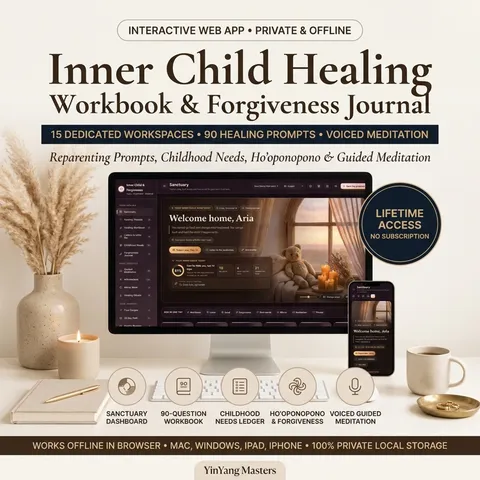
 内在小孩疗愈练习册与宽恕日志 — 互动式自我再养育网页应用
- 一个网页应用取代练习册、信件盒和冥想应用:问题、给小时候的信、需求记录、宽恕日志和语音冥想都在一处,手机或电脑都能用。
- 按自己的节奏,回答觉察、拥抱、再养育、宽恕四个阶段的 90 道温和问题。
- 附上童年照片给小时候的自己写信,并记录每天满足了八种童年需求中的哪些。
 阴影工作日记与声音疗愈指南 — Shadow Work Journal & Sound Healing Guide,触发记录与 Solfeggio 频率
- 记录每次被触发时的身体感受、前后强度(0–10)和使用的方法。
- 每周图表和方法排行告诉你什么真正能让你平静。
参考来源与核验资料
- [1]Wikipedia — John Bradshaw (author) ↗
- [2]Wikipedia — Inner Child ↗
- [3]Wikipedia — Reparenting ↗
- [4]Wikipedia — Self-Compassion ↗
依据正念实操与个人成长编辑规范审校。 编辑政策

配套交互式手册与系统

真实故事
查看全部故事 →读者如何因这些练习而改变
这些年里,拥有240万多名关注者的社群(含3.8万+名学员)持续分享坚持每日练习后的真实成果。
 爱情故事
双生火焰日记有用吗?真实故事与每日练习
双生火焰日记真的有用吗?分享走出分手、迎来灵魂伴侣、找回平静的真实经历,并展示每天的练习在日记里是什么样子。
阅读指南 金钱故事
金钱显化日记有用吗?真实故事
金钱显化日记真的有用吗?分享还清欠款、争取加薪、缓解金钱焦虑的经历,并展示每天的练习在日记里是什么样子。
阅读指南
 爱情故事
分手后如何显化爱情:真实疗愈故事
分手后如何显化爱情?分享人们如何用自爱肯定语、照镜子练习和爱情日记先疗愈自己,再重新敞开心扉的真实经历。
阅读指南 金钱故事
显化无债生活:稳步还清欠款的真实故事
如何显化无债生活?分享人们如何把金钱肯定语、丰盛日记与清晰目标、截止日期和每日证据结合起来,稳步走向无债。
阅读指南 爱情故事
显化灵魂伴侣:从内在开始的真实故事
如何显化灵魂伴侣?分享人们如何写下理想伴侣脚本、制作爱情愿景板,并在爱到来之前先对生活说“好”。
阅读指南 金钱故事
显化加薪:自信开口的真实故事
如何显化加薪或升职?分享人们如何清理金钱信念、练习自信肯定语,并在开口前记录下自己的成绩。
阅读指南 爱情故事
双生火焰重逢故事:走向平静的真实旅程
真实的双生火焰重逢故事:人们如何借助旅程阶段、征兆记录和引导冥想,在分离期间找回平静,无论最终是否重逢。
阅读指南 金钱故事
从金钱焦虑到与钱和解:真实故事
分享缓解金钱焦虑的经历:查看账户前听一段简短的引导冥想,每周一次金钱约会,并温和地审视旧信念。
阅读指南
相关指南

更多文章



热门内容
本周读者最常打开的内容
按过去 7 天的真实访问量排序。




免费互动指南
免费领取 2027 天使数字年度地图
通过邮件领取《2027 天使数字年度地图》,内附 2027 个人年速查、每月指引天使数字与专属年度意图书写空间。
关注我们
每天的仪式,就在你的动态里
Yin Yang Masters 的简短指南、月相仪式和计划本使用教程。





在 AI 助手中直接询问 Yinyang Masters
在聊天中获得同样的计算与指引:添加免费的 Yinyang Masters 应用,然后用日常语言提问。无需注册账号。
试着问: “找一篇关于开始每日灵性练习的 Yinyang Masters 指南。”

正在直播
认识 Moon Keeper,我们的直播祭坛守护者
Moon Keeper 每小时观察星象、抽一张塔罗牌,并分享一段 3 分钟的静心练习。来祭坛看看,关注每小时日记,并在留言簿里写下你的话。

每日免费通讯
每天收到 Yin Yang Masters 通讯
每天一封简短邮件:一个今日练习、一个读者的真实故事,以及关于爱情、财富与内心平静的最新指南。
8多年来,超过240万名关注者和3.8万+名学员组成的社群,分享了坚持这些练习后在爱情、财富和内心平静上的真实变化。